


Viruses MDPI: Journal Spotlight
In this edition of our Journal Spotlight, we will be exploring the achievements, milestones, and thriving global community of Viruses (ISSN 1999-4915), a leading, peer-reviewed, Open Access journal of virology.
Editor-in-Chief: Dr. Eric O. Freed
Current Impact Factor: 3.5
Current CiteScore: 7.7
Statistics as of March 2026
A Viruses MDPI timeline
- 2009 – Inaugural issue was released
- 2010 – Viruses was indexed in Scopus (Elsevier) and SCIE (Web of Science)
- 2019 – 10th Anniversary of Viruses
- 2020 – Viruses published its 5,000th paper
- 2025 – Viruses received its 2024 Impact Factor (3.5) and CiteScore (7.7)
- 2026 – Viruses hosted the New Horizons in Virology 2026 conference
Editor-in-Chief
Dr. Eric Freed is Viruses’ founding Editor-in-Chief and has played an instrumental role within the journal’s ongoing success since it was established in 2009.
His longstanding commitment to the field of virology is further demonstrated through his role as Director of the HIV and Dynamics Replication Program at the National Cancer Institute, which he has held since 2003.
Dr. Freed’s expansive contributions to the scientific literature have focused on understanding the mechanisms of HIV replication, encompassing HIV-1 Gag trafficking, Env incorporation, virus assembly, budding, release, maturation, and drug resistance.
In an interview at the recent New Horizons in Virology conference, Dr. Freed proudly shared how the journal has grown since publishing its inaugural issue:
“When we started, we had no website, we we’re not indexed by any of the leading indexers of scientific publications. I read all the papers. I edited them, in some cases for grammar. We’ve now become the publisher of the largest number of virology papers in the world. So, I’ve been proud to see how much its grown over the last 16 years”

Dr. Eric Freed at New Horizons in Virology
Aims and scope
In Viruses’ first editorial piece, Dr. Freed upheld the undisputed importance of virology research and study.
While its implications for the betterment of global human health and welfare are clear, the study of viruses also helps to expand our knowledge across a broad range of biological disciplines including immunology, cell biology, molecular biology, and evolutionary biology.
The journal itself benefits from a broad scope which covers human and animal viruses and also insect, plant, and bacterial viruses. The subject areas featured inside the journal include, but are not limited to:
- Viruses
- Virus classifications
- Virus-like agents
- Vaccines
- Viral immunology
- Antiviral drug development.
See the journal’s full scope here.
Journal metrics

Most cited
As of April 2026, the Viruses’ publication with the most citations is ‘Virology, Epidemiology, Pathogenesis, and Control of COVID-19’.
Impact Factor
Currently, Viruses’ Impact Factor sits at 3.5.
The journal is positioned in Q2 for the ‘Virology’ Journal Citation Report (JCR) category.

CiteScore
Since 2020, Viruses’ CiteScore rating has continued to grow each year. Most recently, its CiteScore was calculated to be an impressive 7.7, its highest score since publication began.
Additionally, the journal is placed in the highest quartile (Q1) for two subject categories: ‘Virology’ and ‘Infectious Disease’.

Indexing
Viruses is indexed within a vast range of databases and archives, including:
- Scopus, Embase, Reaxys (Elsevier)
- SCIE, Biological Abstracts, BIOSIS Previews (Web of Science)
- AGRICOLA, PubAg (National Agricultural Library)
- DOAJ
- J-Gate
- Gale
- OpenAIRE
- ProQuest
Find the complete list of associated indexing services here.
Altmetrics
Altmetrics are an alternative metric which provides insight into how research is shared online.
As of April 2026, Viruses has been mentioned 154,275 times across social media platforms, 10,414 times across various news outlets and blogs, and 5,578 times across policy documents and patents.
The Viruses community
Viruses engages with its academic community through MDPI’s Awards program, multiple society affiliations, and by hosting a series of successful conferences.
Awards
To recognize emerging scholars and enhance communication among scientists, Viruses offers various awards to researchers in the field of virology.
The journal offers the Travel Award and the Early Career Investigator Award. Both aimed at young researchers, these awards demonstrate Viruses’ commitment to nurturing the next generation of exceptional scientists.
Society collaborations
As a leading Open Access journal of virology, Viruses enjoys multiple partnerships with societies across the globe.
Members of the following societies contact their society representative to learn more about the benefits of publishing with MDPI, such as discounts on article processing charges (APC):
- Australasian Virology Society (AVS): The Australasian Virology Society aims to promote, encourage, support and advocate for the discipline of virology in the Australasian region.
- Brazilian Society for Virology (BSV): Established in 1986, BSV supports the development of basic and applied virology in South America. The society promotes the exchange of information and stimulates the collaboration among virologists.
- Canadian Society for Virology (CSV): CSV helps virologists interact and exchange ideas and support the training of the next generation of researchers. They work to accelerate the translation of research findings to positive outcomes for Canadians.
- Global Virus Network (GVN): Representing more than 80 sites from more than 40 countries, GVN was founded in 2011 and is dedicated to understanding, preventing, and eradicating viral human diseases. The lead innovative programs designed to support and promote research that bridges the gap between virus surveillance and public health implementation.
- Italian Society for Virology (SIV-ISV): SIV-ISV facilitates career opportunities, scientific interactions and collaboration among researchers, teachers, professionals and experts, with a particular focus on the development of young scientists.
- Spanish Society for Virology (SEV): The main objective of SEV is to endorse basic and applied virology both to key stakeholders and the wider society and stimulate discussion and collaboration among virologists.
Conferences
Conferences present a valuable opportunity for academics to connect with their wider scientific community.
In March 2026, MDPI hosted the New Horizons in Virology 2026 conference, the 6th edition of the Viruses conference series. Consisting of nearly 200 attendees from 40 different countries, the event featured a range of insightful sessions and provided an outlet for scholars to collaborate and discuss current issues in the field of virology.
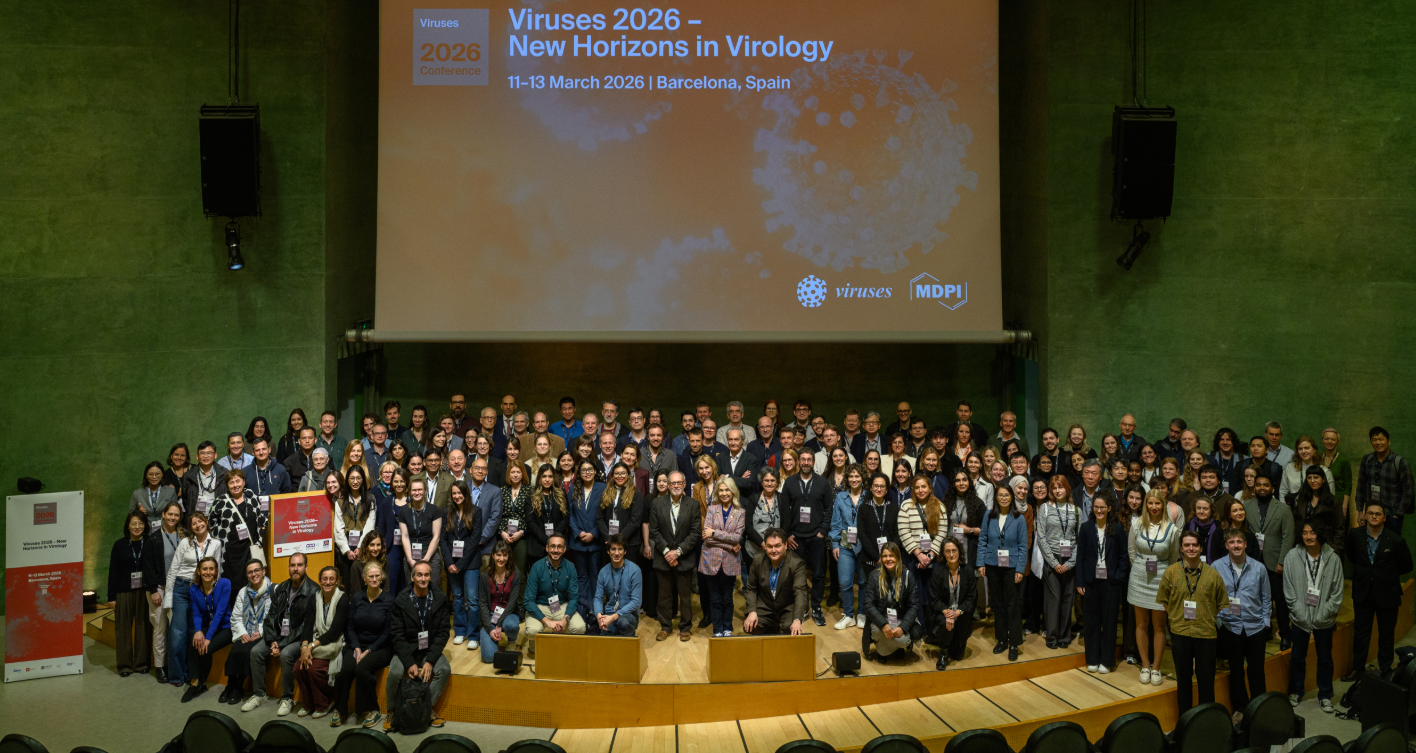
Learn more about New Horizons in Virology, Viruses 2026.
Viruses will also be represented at The 2026 International Online Conference on Tropical Medicine and Infectious Disease, taking place between 1 and 2 July 2026, and ncRNA2026—From Molecular Mechanisms to Clinical Impact, taking place from 24–26 June 2026 in Leuven, Belgium.
Visit Viruses’ events page to learn more.
Testimonials
“MDPI is a publisher that reviews articles quickly, professionally and ethically. With committed editors and quality reviewers. It is always important to publish with MDPI because of its high visibility and impact factor in the scientific community.” — Felipe Masiero Salvarani, author in Viruses.
“The journal Viruses provides an outstanding platform for publishing high-quality research in virology. The submission process is smooth and user-friendly, and the editorial team ensures efficient handling at every stage.” – Ramya Akurathi, author in Viruses.
Submitting a manuscript
Manuscripts for Viruses should be submitted online at susy.mdpi.com.
Prior to submitting, we recommend that authors explore the useful resources on our instructions for authors webpage.
To submit your manuscript, register and login to the submission website. Once you have registered, click here to go to the submission form. The submitting author, who is generally the corresponding author, is responsible for the manuscript during the submission and peer review process.
All co-authors can see the manuscript details in the submission system if they register and login using the e-mail address provided during manuscript submission.
If you’d like to find out more about Viruses and its publication process, please visit the journal website.
Stay up-to-date with Viruses MDPI: