


Journal of Intelligence MDPI: Journal Spotlight
Intelligence is one the most fundamental and defining characteristics of human existence. It has forged societies, built economies, and driven once unimaginable technological change. Understanding intelligence, what it is and how it has evolved over time, offers crucial insight into why humans behave the way we do.
This month, our Journal Spotlight is shining on Journal of Intelligence (ISSN 2079-3200), an international, peer-reviewed, Open Access journal on the study of human intelligence, published monthly online by MDPI.
Here, we discuss the journal’s growing list of achievements, charting its growth into a premier platform for high-quality research on human intelligence.
Editor in Chief: Professor Dr. Con Stough
Current Impact Factor: 3.4
Current CiteScore: 4.7
Statistics as of January 2026.
A history of J. Intell.
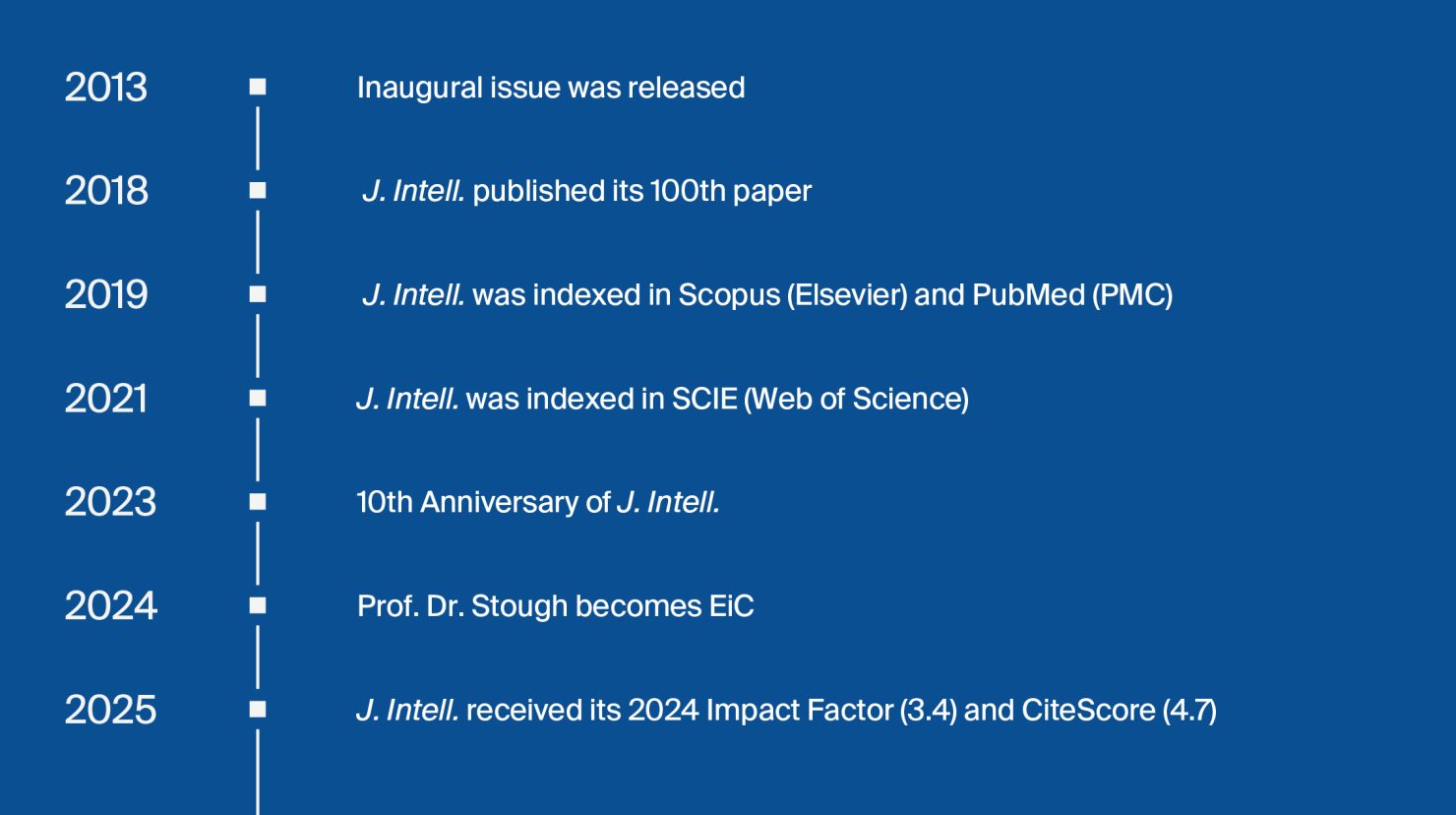
The inaugural issue of the Journal of Intelligence (J. Intell.), was released in 2013, following a quarterly publication schedule. Led by its first Editor-in-Chief, Professor Dr. Paul De Boeck, J. Intell. began to build a wealth of research into the study of human intelligence and would publish its 100th paper in 2018.
Following this impressive milestone, the journal continued its upward trajectory and began to boost its visibility across significant indexing databases. In 2019, the journal was indexed in PubMed (National Library of Medicine) and Scopus (Elsevier), and in 2021 J. Intell. would be indexed in SSCI (Clarivate).
Professor Dr. De Boeck’s tenure as EiC would come to an end in 2021, having left an incredibly influential impact on the journal. As Editor-in-Chief, Prof. Paul De Boeck guided J. Intell. through its infancy into a recognised scholarly journal. Under his successor, Professor Dr. Andrew Conway, the journal hit its 10-year anniversary and received its first Impact Factor.
The journal’s current Editor-in-Chief, Professor Dr. Con Stough, assumed editorial leadership in June 2024 and brings a wealth of experience to the position. Prof. Dr. Con Stough has worked as a professor of cognitive neuroscience and psychology at Swinburne University since 1995. He has been a member of several scientific bodies, including the Society for Neurosciences, the Advancement for Psychological Sciences, and the American Psychological Association.

Professor Dr. Con Stough, Editor in Chief (2024-current)
“As an open access journal, papers in the journal should be easily available to other researchers and the wider community increasing the impact of our publications and hopefully attracting attention from people who can translate the research into positive outcomes in our world.” – Professor Dr. Con Stough.
Aims and scope
J. Intell. is devoted to advancing the scientific understanding of human intelligence, an essential feature of what it means to be human. The journal aims to provide insight into questions such as where intelligence comes from, what it is, how we can measure it and what its consequences are.
The journal publishes empirical and theoretical studies, reviews, commentaries, and case studies that span psychometrics, cognitive and neuroscientific approaches, quantitative modelling, and emerging interdisciplinary perspectives.
As outlined in the journal’s first editorial piece, MDPI’s Open Access publishing model provides clear advantages for the journal. It ensures that the high-quality research is freely available to the researchers, educators, and policymakers who can apply it into scientific progress and increased societal well-being.
While research into human intelligence remains its primary focus, the journal’s scope also invites research on emotional and social intelligence, as well as insights gained from artificial intelligence.
You can find the journal’s full scope here.
Journal Metrics

As of January 2026, the J. Intell. publication which has received the most citations, views, and downloads is a review article entitled “Creativity, Critical Thinking, Communication, and Collaboration: Assessment, Certification, and Promotion of 21st Century Skills for the Future of Work and Education”.
Published in 2023, this work explores the concept of “21st century skills” which pertains to various soft skill competencies known as the “4Cs”: creativity, critical thinking, collaboration, and communication. It aims to demonstrate how these skills can be formally recognised by educational institutions to better prepare learners for the future of work. Interestingly, this paper’s success extends beyond quantitative measurements, with it being featured within policy documents from the Government of Ireland exploring teenagers in educational contexts.
The frequency of citations received by the average article in an academic journal in a particular year can be calculated using Journal Impact Factor (Journal Citation Report, Clarivate). J. Intell. holds a respectable Impact Factor of 3.4. The journal is also ranked in Q1 in the Journal Citation Report ranking for ‘Psychology, Multidisciplinary’. These statistics can be attributed to the hard work and dedication of numerous people, from Editorial Board Members (EBMs) to reviewers.

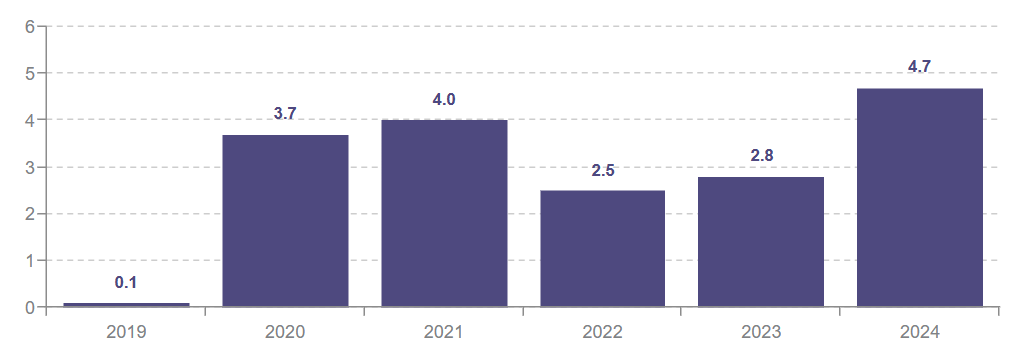
Providing a similarly useful measurement to estimate a journal’s scholarly impact, CiteScore (Elsevier) calculates the average number of citations received by the journal over a 4-year period. First receiving a score of 0.1 in 2019, J. Intell continues to grow substantially in this measurement. The journal currently holds a CiteScore of 4.7 — its highest rating to date. Perhaps equally impressive is that the journal comfortably sits in Q1 for the CiteScore rankings ‘Education’ and ‘Experimental and Cognitive Psychology’.
J. Intell continues to flourish and is featured across an array of indexing databases and archives; these include Scopus (Elsevier), SSCI (Web of Science), DOAJ, OpenAIRE, and more. Find a comprehensive list of associated indexing services here. J. Intell’s impact also extends beyond traditional scholarly measurements. The journal has received 6,570 mentions across social media, 421 mentions across multimedia news sources, and a further 22 mentions across policy documents, patents, and guidelines.
The J. Intell. Community
The journal engages with its scholars through MDPI’s Awards program and by hosting conferences.
Awards
J. Intell. joins a collective of MDPI journals who are committed to uplifting the contributions of its scholars and boosting communication amongst scientists.
Do you have a PhD thesis exploring the concept of human intelligence? The application deadline for its Best PhD Thesis Award is fast approaching. Applications close on 28 February 2026.
The winners of its most recent Outstanding Reviewer Award are set to be announced on 31 March 2026, and the recipients of the Best Paper Award will follow on 30 June 2026.
You can find a full list of J. Intell.’s Awards here.
Conferences
For journals, conferences present a valuable opportunity to connect with their wider academic community.

Organized by J. Intell., the 1st International Online Conference on Human Intelligence (IOCHI 2026) is scheduled to take place online from 25 to 26 March 2026. The conference will bring together experts from around the world who are currently working in human intelligence and provide an online forum for sharing and exchanging knowledge.
Marking the journal’s first conference, the event represents an impressive milestone within its development. Further, virtual events facilitate connection between scholars across the world, removing geographical barriers which may prevent researchers attending in-person conferences.
If you are interested in attending, you can find all the important details here.
Testimonials
“Reviewing for MDPI has been a smooth and professional experience. The platform is intuitive, and the process allows reviewers to provide constructive feedback efficiently.” – Mayra Carrión-Toro, reviewer for J. Intell.
“The editorial staff were thorough, polite and helpful. This is the first time publishing with MDPI and I was very excited to explore their process.” – Shane Phillipson, author for J. Intell.
Submitting a manuscript
Manuscripts for J. Intell. should be submitted online at susy.mdpi.com. Prior to submitting, we recommend that authors explore the useful resources on our author guidelines webpage.
The submitting author, who is generally the corresponding author, is responsible for the manuscript during the submission and peer review process.
To submit your manuscript, register and login to the submission website. Once you have registered, click here to go to the submission form. All co-authors can see the manuscript details in the submission system if they register and login using the e-mail address provided during manuscript submission.
If you’d like to find out more about J. Intell. and its publication process, please visit the journal website.
Stay up to date with J. Intell. on social media: