
Languages MDPI: Journal Spotlight
To commemorate its 10th anniversary, this month we will be shining our journal spotlight onto Languages (ISSN 2226-471X).
Languages is an international, multidisciplinary, peer-reviewed, Open Access journal committed to understanding the world’s languages in all its diversity, published monthly online by MDPI.
The journal is covered in ESCI, Scopus, and other databases, and has published more than 1000 papers from more than 3000 authors. In celebration of its 10th anniversary, we reflect on its key achievements which have contributed to its enduring success.
Co-Editors-in-Chief: Prof. Dr. Anthony Pak-Hin Kong and Prof. Dr. John Nerbonne
Current Impact Factor: 1.2
Current CiteScore: 1.8
Statistics as of March 2026
A Languages MDPI timeline
- 2016- Inaugural issue was released
- 2018 – Languages was indexed in ERIH Plus
- 2019 – Languages was indexed in ESCI (Web of Science)
- 2020 – Language was indexed in Scopus (Elsevier)
- 2022 – Languages published its 500th paper
- 2025 – Languages received its 2024 Impact Factor (1.2) and CiteScore (1.8)
- 2026 – 10th Anniversary of Languages
Editors-in-Chief
Since 2024, Languages holds the benefits of having two committed Editors-in-Chief, both bringing unique perspectives and insights to the journal’s leadership position.
 Prof. Dr. Anthony Pak-Hin Kong (left) and Prof. Dr. John Nerbonne (right)
In 2024, Prof. Dr. Anthony Pak-Hin Kong began his tenure as Co-Editor-in-Chief. He holds many notable positions including Director of Aphasia Research and Therapy (ART) Laboratory at Hong Kong University and a Fellow of the American Speech-Language-Hearing Association. His primary research interests include aphasiology, disordered discourse analyses, and neurogenic communication impairments in multilingual speakers.
Prof. Dr. John Nerbonne became Co-Editor-in-Chief at the start of the year and boasts a similar wealth of experiences across industry and academia. Prof. Dr Nerbonne served as a Professor at University of Groningen for more than 20 years and is an elected member of the Royal Netherlands Academy of Arts and Sciences. His research interests include developing computational tools for analysing pronunciation differences.
Aims and scope
To aptly capture the diversity of languages, and the way they operate within our society, the journal features a broad scope. Its aims and scope were updated in 2024, with previous Editor-in-Chief Prof. Jeanine Treffers-Daller sharing her renewed vision for the journal:
“Languages aims to present discussions of and developments in multidisciplinary research, thereby generating broad and practical applications for the study of languages in the current world.“
The scope of Languages includes topics such as applied linguistics, communication sciences and disorders, psycholinguistics, and endangered languages. A full list of topics can be found here.
Journal metrics

Most cited
With a growing scientific community of more than 1,812 publications, the Languages paper with the highest number of citations and views is ‘An Exploratory Study of EFL Learners’ Use of ChatGPT for Language Learning Tasks: Experience and Perceptions’.
Impact Factor
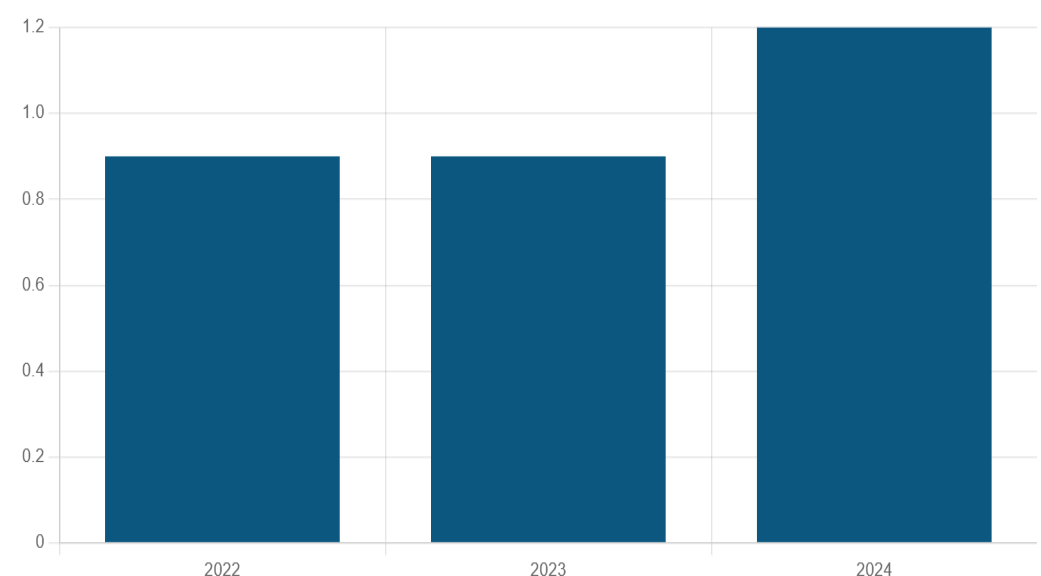
Building on its first Impact Factor of 0.9 in 2022, the journal’s most recent Impact Factor rating of 1.2 highlights its continued improvement.
Currently, the journal is positioned in Q2 for the ‘Linguistics’ Journal Citation Report (JCR) category.
CiteScore
Similarly to its Impact Factor, Languages CiteScore rating continues to climb. It has seen sustained growth over the last 5 years and currently sits at 1.8.
Impressively, the journal is placed in the first quartile (Q1) for two subject categories: ‘Language and Linguistics’ (Arts and Humanities) and ‘Linguistics and Language’ (Social Sciences).

Indexing
Languages is indexed within an expansive range of databases and archives, including:
- Scopus (Elsevier)
- ESCI (Web of Science)
- DOAJ
- J-Gate
- Gale
- OpenAIRE
- ProQuest
Access the complete list of associated indexing services here.
Altmetrics
For journals in Social Sciences, and Arts and Humanities, altmetrics prove useful at capturing the broader societal resonance of a publication’s content.
As of March 2026, Languages has been mentioned 2,289 times across social media platforms, 119 times across various news outlets and blogs, and 28 times across policy documents and patents.
The Languages community
Through various awards and affiliations, the journal is committed to fostering positive relationships with the academic community which it serves.
Awards
In engaging in MDPI’s award program, Languages continues to celebrate the achievements of its scholars.
The application deadline for its Best PhD Thesis Award is on 30 June 2026.
The journal also has several upcoming winner announcements, including the Languages Best Paper Award on 30 June 2026 and its Editor of Distinction Award on 31 March 2027.
Learn more about the awards the journal offers here. Also, read our blog article covering everything you need to know about MDPI’s award program.
Affiliations
Languages is affiliated with the European Society for Transcultural and Interdisciplinary Dialogue (ESTIDIA) which offers a forum for cross-disciplinary and multi-level dialogue on human communication, learning mechanisms, interpersonal relations, and socio-political processes, amongst other topics.
ESTIDIA works to establish trans-national collaboration across international research projects, and to foster critical thinking in academic and professional endeavours.
Members of ESTIDIA should contact their society representative to learn more about the benefits of publishing with MDPI, such as discounts on article processing charges (APC).
Testimonials
“This journal promotes Open Access publishing, which has come to be understood as very important in disseminating research. Globally influential researchers’ papers are published on the same page where my paper is now published. The speed and quality of academic review, and advice, were outstanding. I recommend this journal to all scholars.” – David Coulson, Ritsumeikan University. Author in Languages.
“I wholeheartedly encourage any competent reviewer to reach out to MDPI. I can think of no better way to promote Open Access and support junior authors on their way to brilliant careers in science!”- Lorenzo Maselli, Universiteit Gent. Reviewer for Languages.
Submitting a manuscript
Manuscripts for Languages should be submitted online at susy.mdpi.com.
Prior to submitting, we recommend that authors explore the useful resources on our instructions for authors webpage.
To submit your manuscript, register and login to the submission website. Once you have registered, click here to go to the submission form. The submitting author, who is generally the corresponding author, is responsible for the manuscript during the submission and peer review process.
All co-authors can see the manuscript details in the submission system if they register and login using the e-mail address provided during manuscript submission.
If you’d like to find out more about Languages and its publication process, please visit the journal website.