
When Food Systems Fracture: Pathways to Crisis in the UK
Food systems throughout the world are independently sophisticated and highly interconnected. In the UK, to effectively feed nearly 70 million people, modern agriculture relies heavily on scientific innovation, digital and physical infrastructure, fossil-fuel based energy systems and efficient transportation networks.
The complex and dynamic nature of global food production and supply has left it extremely fragile. There is increasing concern in advanced economies about risks of disruption and crisis in such systems. Despite increased recognition of this risk, current approaches are thought to lack a broader, holistic perspective of the current situation. This is thought to underestimate the potential for events to trigger an acute food crisis and lead to civil unrest.
A new study, published in the Open Access journal Sustainability, used a structured expert consultation process to explore how an acute food crisis could unfold in the UK. Rather than focus solely on isolated risks, the team mapped out interconnected pathways and identified how acute triggers could compound with existing chronic vulnerabilities to precipitate a crisis. They also identified some interventions that could mitigate the mentioned triggers.
Overall, the work provides a deeper understanding of the pathways that sustain global agriculture and proposes guiding principles for designing future policy. Professor Sarah Bridle, author of the study, summarises the importance of the study:
“While there is a growing awareness of the potential risks, not enough coordinated work is being done to address the weak spots in the system, and how people are likely to be affected. Understanding how the system might react to extreme pressure is the first step to preventing worst-case scenarios unfolding in the future.”
Current fragilities within the system
Since 1950, global food production has grown rapidly. The green revolution introduced high yielding crop varieties and the widespread use of fertilisers. While this has, in principle, reduced food poverty across the globe, it has also introduced new risks into the food system:
- Environmental and climate instability. Modern food production depends on stable weather, healthy soils and biodiversity. Climate change has resulted in unpredictable and volatile weather, which creates food production shocks globally.
- Energy and industrial dependence. Highly mechanised, fossil-fuel dependent agriculture is exposed to energy price rises and relies on complex scientific and digital technologies to function.
- Concentrated and tightly optimised supply chains. Global food production is concentrated in a handful of “breadbasket” regions and moved through centralised transport chokepoints via just-in-time logistics, leaving little redundancy when disruptions occur.
- Underlying social and economic vulnerability. Unequal food access, rising living costs, inequality and declining public trust mean that price spikes or short-term shortages can escalate into wider societal instability.
Existing issues within society
The authors emphasise the importance of distinguishing between chronic and acute risks. Chronic issues are long-standing pressures that weaken the system over time. This can include climate-related issues such as climate change and biodiversity loss. Policies to tackle these issues contribute to increased competition for land and decrease the profitability of UK farming. Relying on importing food products sees a dependence on transportation and digitisation that makes the system more vulnerable.
Additionally, they highlight how the UK is currently experiencing several society-related issues. A period of chronic price inflation and food price volatility is coinciding with rising poverty and inequality, all contributing to an overall cost-of-living crisis. Food insecurity can have detrimental effects on an individual’s mental health, creating an emotional toll of struggling to provide meals. These experiences can influence public trust and community cohesion, both of which are vital for societal stability especially during times of acute crisis.
Defining a food crisis
As part of the research, the authors consulted 31 experts, selected based on their knowledge of food systems across policy, business, academia, charities, or communities. They conducted 15 expert interviews, followed by three surveys and two workshops with a further 16 experts.
For the purpose of this study, an ‘acute food system crisis’ was defined as a situation where:
‘People lack access, availability or cannot afford enough safe, nutritious food, leading to an acute increase in numbers of people anxious about the extreme impact on quality of life (e.g., due to hunger, malnutrition, disease outbreak, civil unrest).’
This definition emphasises the importance of nutrition in food, rather than a focus on calories alone. It also uses the words ‘acute’ and ‘extreme’ to acknowledge that many families already face food insecurity from existing chronic issues. Further, the definition focuses on levels of anxiety within the population. It was perceived that this would be the major cause of an acute crisis.
Three acute triggers
Considering existing chronic pressures, a shortlist of potential triggers was identified. This was narrowed to three interconnected pathways that could escalate into a food crisis. Figure 1 illustrates how these triggers interact with underlying vulnerabilities and how, together, they may culminate in a systemic shock.
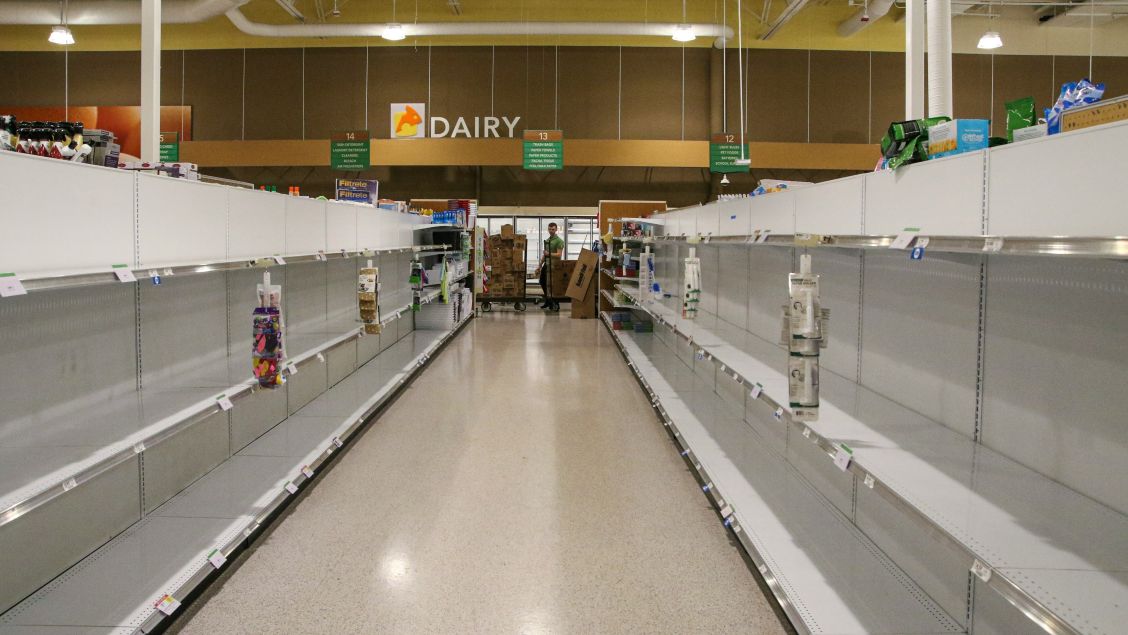
- Cyber-attacks: Modern food systems rely heavily on digital technology to coordinate deliveries around the globe. An attack on these systems could affect the just-in-time supply chains used in the UK and even brief interruptions could result in empty shelves.
- Extreme weather events: Climate change has already increased the frequency and intensity of extreme weather. Droughts or floods in “breadbasket” regions causing crop failure could reduce food availability and drive price volatility. These events may also affect transportation routes, labour availability and energy systems.
- International conflict: Geopolitical instability can disrupt trade flows, energy supplies and access to commodities such as fertilisers. A major new conflict could trigger food price spikes, trade restrictions or supply shortages.

Figure 1: An illustration of how the acute triggers connect with existing chronic issues with the potential to cause an acute food system crisis.
From shock to unrest
Any combination of the three triggers mentioned above could lead to food shortages and sudden price increases. Whether these scenarios prompt an acute food system crisis depends on how the authorities respond and the strength and adaptability of communities.
During times of food shortages, people tend to resort to panic buying. This behaviour makes the problem worse and can lead to an increased black market of stolen food. This unregulated market can lead to unsafe food practices leading to foodborne illness. Furthermore, less wealthy people could be completely priced out of such markets, increasing social tension and marginalisation.
The experts emphasised that the outcomes of any situation arising from the triggers identified relies heavily on public trust, communication strategies and social cohesion. Dominic Watters, a contributor to the study, describes how an acute trigger could lead to a crisis:
“Food crises and civil unrest don’t come from a lack of calories alone; they come from a lack of dignity, voice and care. This research highlights how the stigma and dehumanisation of food insecurity are already creating cracks in our society.”
Building resilience
Importantly, the study moved beyond risk identification to consider interventions. 28 potential measures were prioritised, with an overall strong preference for system-wide reforms rather than narrow technical fixes.
The highest ranked intervention was ‘longer-termism in policy planning’, which calls for policy planning beyond 5-year political cycles in the UK. Resilience is a critical goal for the food system, and it requires sustained coordination across all government departments, including those responsible for health, trade, education and housing.
Other system-wide priorities included:
- Cross-government food systems thinking.
- Stronger collaboration between government and industry.
- Inclusion of diverse voices, particularly marginalised communities, in food policy discussions.
- Improved digital and physical infrastructure security.
Specific measures were also identified for different pathways. For extreme weather, experts supported agroecological and regenerative farming practices. For geopolitical risks, diversifying supply chains and strengthening renewable energy capacity were prioritised. To cushion price shocks, robust social security systems and emergency cash transfers were considered critical.
Professor Aled Jones, a corresponding author on the study, described the ideal approach for future interventions:
“The UK is not immune to disruptions that can lead to severe consequences. Policymakers must adopt a long-term perspective to policy planning, and work across departments and wider food system stakeholders to ensure a whole-systems approach to addressing the problems.”
Rethinking food security in advanced economies
Food crises are often events associated with low-income countries. However, this work demonstrates that high-income nations are not immune to cascading disruptions in food infrastructure. The combination of global interdependence, climate instability and social inequality creates conditions in which acute shocks could have far-reaching consequences.
While the likeliness and precise form of such a crisis remain uncertain, the study highlights the importance of preparation. By examining the chronic vulnerabilities that exist within society and how these interact with acute triggers, policymakers can move from reactive crisis management towards implementing more proactive resilience-building strategies.
As global systems become more interconnected, understanding these pathways may prove essential, not only for safeguarding food supply, but for maintaining social stability in an increasingly uncertain world.
More studies on exploring policies for the future can be found across the Open Access journals Future and Sustainability. Alternatively, you can access the full MDPI journal list here.