

Increasing Access to Knowledge Beyond Research Articles
This year’s theme for International Open Access Week is ‘The Cost of Knowledge’, exploring whether researchers and their communities are the rightful owners of what they discover, what price is worth paying to make it available to everyone, and who is bearing the cost.
As the leading fully Open Access publisher, MDPI has spent more than 30 years working through these questions by removing the cost of access for readers. In 2026, MDPI published its two-millionth article. This milestone was reached together through consistent collaboration with a global network of authors, editors, and reviewers.
Removing the cost for readers is only one part of MDPI’s commitment to advancing open science. In this article, we explore how MDPI’s publishing model enables further investment in increasing access to knowledge, opportunities, services, and platforms.
MDPI’s Gold Open Access model
Through MDPI’s Gold Open Access publishing model, research results are made available to access and reuse by anyone, anywhere, immediately upon publication.
MDPI funds the costs associated with Open Access through article processing charges (APCs). This approach is widespread, with Gold Open Access being the most used type of Open Access for all the top 30 countries by output, according to Scopus.
In contrast, subscription-based publishing functions by placing research results behind paywalls. To access knowledge, researchers typically rely on access through their institutions. This was the traditional publication model for publishers.
The subscription-based model restricts access to knowledge in the following ways:
- Subscription barriers hinder collaboration by limiting the circulation of knowledge. Therefore, potential collaborations may be prevented, such as in interdisciplinary fields, ultimately slowing down the pace of scientific progress.
- Subscription barriers limit access to knowledge to those paying the fees, preventing the broader dissemination of knowledge to the public or to institutions operating under financial constraints.
Today, Gold Open Access is not only the dominant route compared to other Open Access options, but it surpasses the subscription-only route for all global regions except Asia, according to Scopus.

Figure 1: Global scholarly publishing by access type, number of publications; data from Scopus.
As seen in Figure 1, there has been a sharp rise in Gold Open Access in recent years. In support of this trend, governments, funders, and research institutions around the world are mandating Open Access publication alongside an increase in awareness of its benefits.
MDPI’s publishing model directly serves to boost access to knowledge, with APCs enabling the publication process and further investment in increasing access to knowledge, opportunities, services, and platforms.
For more information on article processing charges, including what it covers and a full list of journal-specific APCs, please click here.
Ensuring knowledge is freely available, trustworthy, and easy to find
MDPI’s mission to advance open science is driven by its guiding principle that knowledge should be freely and easily accessible to all.
Financed by APCs, MDPI’s publishing model directly empowers this mission by making research viewable, downloadable, and reusable at no cost for the reader. This includes access to more than 500 Open Access journals featuring two million articles.
Sustaining quality at this scale requires continued investment in the teams and infrastructure which enable this process to run smoothly from submission to publication, ensuring the highest editorial standards throughout.
Maintaining quality
Upon submission, all manuscripts are subject to MDPI’s publication process.
Anchored in the principles of quality, fairness, and efficiency, this includes technical and editorial pre-check, rigorous and transparent peer review, production, and publication.
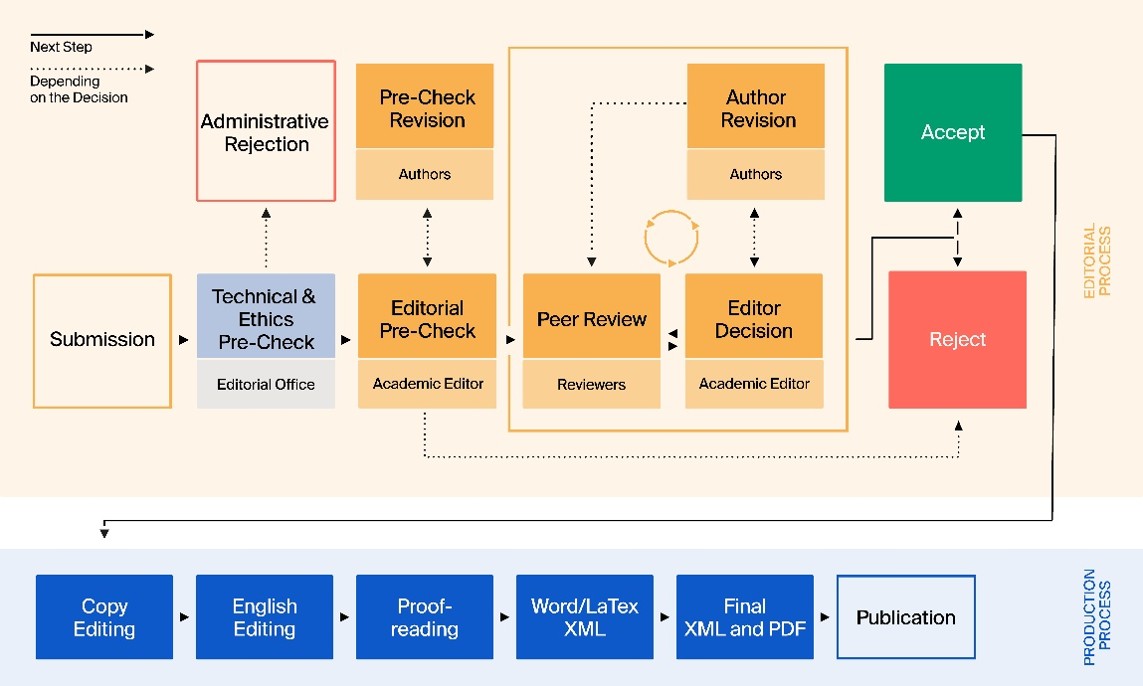
Figure 2: MDPI’s publication process.
Here, manuscripts are rigorously screened by several teams of experts, all with distinct roles in ensuring the quality of publications.
Firstly, members of MDPI’s Editorial Office carry out initial technical and ethical checks. Before the manuscript is sent for review, independent Academic Editors assess its relevancy in relation to the journal’s scope and check for overall scientific soundness.
Then, a minimum of two carefully selected peer reviewers evaluate the manuscript within MDPI’s rigorous and transparent peer review process. Subject to acceptance, professional English editors and production teams then prepare the paper for publication.
During this process, reviewers for MDPI journals may receive 50 or 100 CHF vouchers for conducting high-quality reviewer reports, regardless of whether the evaluation is favourable or critical. This can be applied to a reduction in the article processing charges (APCs) of a future submission to any MDPI journal.
In-house technology that supports editorial judgement
MDPI also invests in developing and employing innovative in-house tools to support the human skill that is at the core of the process.
For example, Ethicality was developed in-house by MDPI’s Technology Innovation team to ensure quality and resolve ethical concerns before publication, comprising a suite of tools and human-in-the-loop validation.
Through Ethicality, manuscripts undergo a series of checks conducted by several AI tools that look for signals of potential ethical malpractice. These include the following:
- Paper mills.
- AI-generated content, such as fake papers and reviews.
- Duplicate submissions.
- Citation manipulation.
- Image manipulation.
- Plagiarism.
Together, these overlapping checks reflect a shared commitment to quality and rigor, helping to ensure that published work is high quality, accessible, and held to the same standards across MDPI’s journals.
Learn more about MDPI’s publication process.
Indexing
After publication, MDPI ensures knowledge is not only freely available, but also highly visible. This can be directly measured through inclusion across indexing databases.
Featuring across indexing databases is an important signal of both quality and visibility. For researchers, institutions, and funders, it demonstrates that MDPI’s journals, and the research published within them, meet the established criteria for discoverability, quality assurance, and scholarly credibility.
As of 2025:
- 330 MDPI journals are indexed in Web of Science.
- 363 MDPI journals are indexed in Scopus.
MDPI journals are also heavily featured across other databases, such as the Directory of Open Access Journals (DOAJ), PubMed, AGRICOLA, ProQuest, and more.
By securing reliable indexing across various databases, MDPI ensures that knowledge can be easily found and that research which informs public policy and technological progress can be easily verified.
Providing free access to journals and published research articles is only one part of MDPI’s mission to facilitate open scientific exchange. MDPI is also committed to increasing access to knowledge through various opportunities, services, and platforms.
Investing in scientific exchange beyond research articles
Producing scientific outputs represents one of many aspects of a researcher’s career. The research process is informed by these other aspects, such as formal teaching, networking, and administrative work.
MDPI recognizes the importance of and actively supports researchers in the valuable work that stands outside the core research process.
Conferences
Conferences provide an opportunity for like-minded researchers to gather and share valuable research, ideas, and expertise. The events improve communication, collaboration, and mutual learning both locally and globally.
As part of its mission to advance open science, MDPI provides an international offering of conferences, including events such as the Z-Forum on Sustainability and Innovation, and conferences organized by MDPI and its journal community.
In 2025, MDPI organised 60 in-person and virtual academic conferences around the world.
Given that conferences provide an incredible opportunity for early career researchers to boost the visibility of their research, MDPI offers the Travel Award to remove barriers preventing scholars from attending conferences, such as financial and geographical factors.
MDPI also sponsors external conferences to further enable the research community to come together and advance knowledge. In 2026, MDPI was a platinum sponsor for both OASPA 2026 and STM Dinner and Conference 2026.
Click here if you want to learn more about upcoming and past conferences.
Awards
Awards are an excellent way to reward the academic community, especially early career researchers. It helps raise their influence, highlighting their outstanding achievements and contributions, and boost communication between scientists.
Accordingly, MDPI offers a wide range of awards to researchers, typically on a journal-by-journal basis. These include the Best Paper, Best PhD Thesis, Travel, Outstanding Reviewer, and Young Investigator Awards, among others.
Importantly, these awards are not just rewarding researchers for embracing Open Access, they are awarding them for doing it exceptionally well.
MDPI presented more than 500 awards in 2025 in recognition and support of researchers worldwide.
This component of MDPI’s support for scientific communities allows journals to give back to the academic community and ensure exceptional scholars receive the attention they deserve.
Tailored training for researchers: academic publishing workshops
MDPI offers free expert-led academic publishing workshops (APWs) to equip researchers with the skills and knowledge necessary to successfully publish their work.
MDPI’s APWs are hosted internationally at universities and institutions by a range of experts to cover various topics that help in preparing for a career in a highly competitive industry. The workshops cover numerous topics that are tailored to the university or institution’s needs, including the following:
- Manuscript preparation.
- Introductions to Open Access.
- MDPI’s editorial process.
- Research and publication ethics.
Participants of MDPI’s workshops gain professional insight into the world of Open Access and publishing, improve their understanding of ethical standards, and learn about the peer review process.
Click here to learn more about MDPI’s academic publishing workshops.
MDPI is committed to giving back to researchers
In such a highly competitive industry, opportunities like awards, conferences, and workshops provide researchers with avenues for recognition, collaboration, and knowledge about the industry.
MDPI is committed to giving back to the scientific community, investing time and resources into empowering researchers.
Services: guiding the transition to Open Access
MDPI has pioneered Open Access for more than 30 years and remains at the forefront of the global shift towards open scientific exchange. As part of this, MDPI values and acknowledges its role as a trusted leader in Open Access.
The shift to Open Access can seem complex, both for individual scholars and institutions. This is why MDPI is committed to guiding scholars and their institutions as they navigate Open Access policies and practices.
Institutional Open Access Program
MDPI recognizes that institutions are central to the future of open knowledge exchange, and its Institutional Open Access Program (IOAP) works to support the transition to Open Access at an institutional level.
Currently, the program has more than 1,000 supported partners across the globe and is built around the goal of widening access to knowledge. It provides clear, structured, and cost‑effective ways to publish Open Access which ensures work originating from these institutions can be freely read, built on, and shared by anyone, anywhere.
Amongst various benefits for institutions and authors, institutions joining the IOAP gain access to a dedicated institutional dashboard via MDPI’s submission system, SuSy.
This offers real-time, COUNTER-compliant reporting, giving them full visibility of their publishing activity. Automatic deposits into institutional repositories help keep this research preserved and discoverable, while supporting compliance with Open Access mandates.
IOAP also widens access to knowledge by providing institutions with expertise and insight from MDPI’s team of regional specialists who understand their unique needs and priorities.
Partners have their own MDPI contact who maintains a hands-on role within account management and can answer invoicing and publishing‑related queries. This ensures smooth communication and efficient issue resolution.
Learn more about MDPI’s IOAP here.
Free resources to learn about Open Access
MDPI uses its industry expertise to share knowledge about the policies, practices, and components of Open Access and open science.
The MDPI Blog features a variety of articles that provide detailed accounts of Open Access mandates in countries around the world.
Given the volume of mandates and differences between countries, navigating these policies can be complex and time consuming. However, understanding these mandates is essential as there may be penalties for not complying with their requirements.
Countries featured across these articles include, but are not limited to:
Also, articles covering Open Access and open science include:
- 6 Benefits of Open Access
- User Rights in Academic Research: Open Access and CC BY
- How Research Funders Support Open Access
- What Are Open Access Repositories?
- Why CC BY Is the Best License for Open Access
- What Are Open Access Mandates?
- All You Need to Know about Open Access
All these articles and more can be found on the MDPI Blog.
Free-to-use open science platforms
MDPI’s mission is to advance open science. Given that Open Access represents one part of the broader open science mission, it actively invests in developing free-to-use open science platforms.
These serve to facilitate dialogue or access to knowledge, in line with the open science movement’s goal to make all aspects of scientific knowledge, not just its outputs, openly available, accessible, and reusable.
The platforms include, among others:
- Preprints.org: a multidisciplinary platform dedicated to making early versions of research outputs permanently available and citable. More than 139,000 preprints are hosted on the platform.
- Scilit: a database of scientific literature containing more than 128 million entries with bibliographic metadata and related services.
- SciProfiles: an innovative social network for researchers and scholars, allowing them to record their research and have open or private discussions. More than 1.1 million profiles are registered on the platform.
MDPI invests in free-to-use open science platforms
Given how much open science practices are being promoted and even mandated around the world, having strong tools and platforms is key to best practice.
MDPI actively invests in developing and maintaining platforms that advance its mission to support research communities and accelerate scientific discovery.
Open Access Week 2026
MDPI’s publishing model directly increases access to knowledge by ensuring all the research outputs published across its portfolio of more than 500 journals are free to read and reuse. This approach has enabled MDPI journals to publish more than 2 million Open Access articles.
Furthermore, MDPI’s publishing model allows for essential investment that increases access to knowledge through opportunities, services, and platforms.
In practice, this ongoing investment enables widespread indexing, conferences, awards, academic workshops, institutional partnerships, and free open science platforms and tools that support researchers at every stage of their careers.
With 30 years of experience, MDPI believes the cost of knowledge is worth paying if the benefits are shared by everyone. Click here to learn more about MDPI is celebrating Open Access Week 2026.
This article was written in collaboration with Tommy Lax, Content Specialist.