
2026 Nobel Prizes: A Celebration of Scientific and Societal Discovery
Every year, the Nobel Prizes bring some of the world’s most significant discoveries into the spotlight. The awards recognise achievements that have conferred the greatest benefit to humankind, influencing both science and the way we live. This year’s prizes were announced between the 5th and 12th October.
Established as a part of the will of Swedish inventor Alfred Nobel in 1900, a year later The Nobel Foundation began rewarding discoveries in the fields of physiology or medicine, physics, chemistry, literature, and peace, with a prize in economic sciences added in 1968.
The Nobel Prize Database contains more than a century of awards; some highlights include:
- 1901 Nobel Prize in Physics: Wilhelm Röntgen for the discovery of X-rays, still widely used in medical diagnosis.
- 1945 Nobel Prize in Physiology or Medicine: Sir Alexander Fleming for the discovery of penicillin, transforming the treatment of bacterial infections.
- 1993 Nobel Prize in Literature: Toni Morrison for novels exploring the experiences of Black Americans in the United States, particularly women.
- 1998 Nobel Prize in Economic Sciences: Amartya Sen for contributions to welfare economics, including research into poverty, famine and access to resources.
- 2004 Nobel Peace Prize: Wangari Maathai for contributions to sustainable development, democracy, and peace through the Green Belt Movement.
- 2018 Nobel Prize in Chemistry: Frances Arnold for pioneering the directed evolution of enzymes, allowing researchers to mimic natural evolution in the laboratory.
This article explores the 2026 Nobel Prizes, explaining the research and discoveries that earned this year’s laureates international recognition.
2026 Nobel Prize in Physiology or Medicine
Karl Deisseroth, Peter Hegemann, and Georg Nagel | For their discoveries concerning light-gated ion channels and optogenetics
Karl Deisseroth, Peter Hegemann, and Georg Nagel were awarded the 2026 Nobel Prize in Physiology or Medicine for discoveries leading to optogenetics, which makes it possible to switch on, or off, the activity of individual nerve cells in a living brain. This method has revolutionised how the brain is studied, allowing researchers to activate memories, create feelings, drive behaviours, and study the types of neurons that are involved in various psychiatric and neurological disorders.
Intrigued by the green alga Chlamydomonas and its ability to react to light more than 20 times faster than the human eye, Hegemann hypothesised that this response must be driven by a much simpler mechanism. Further studies by Hegemann and Nagel led to the discovery of channelrhodopsin-2, a light-gated ion channel that allows ions to cross a cell membrane when exposed to blue light, producing an electrical signal.
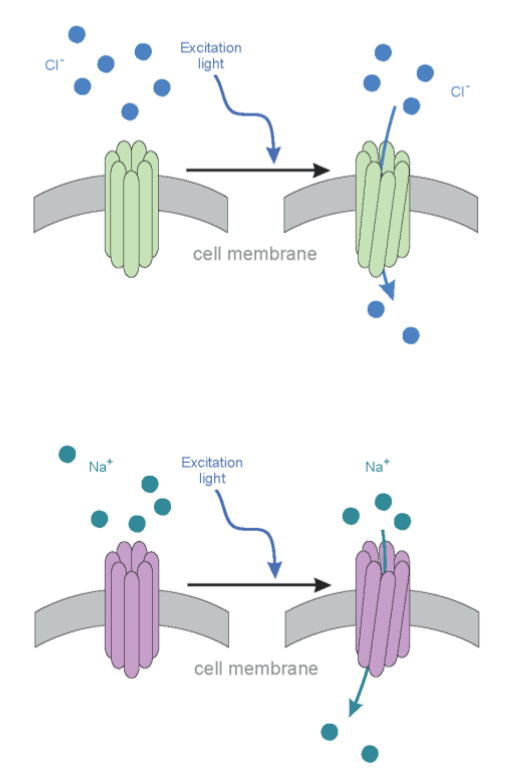
The mechanism of light-gated ion channels. When exposed to light of the excitement wavelength the channel opens, allowing ions to cross and producing a rapid electric signal.
They later introduced the protein into human cells, which produced the same response when exposed to light. This suggested that channelrhodopsin-2 could be used to generate electrical impulses in cells using light.
At the time, researchers lacked precise ways to determine how individual nerve cells controlled behaviour. Deisseroth recognised the potential of channelrhodopsin-2 and introduced its gene into nerve cells, showing that blue light could trigger nerve signals. Further experiments eventually enabled researchers to control specific nerve cells in living brains, giving rise to optogenetics.
This award recognises the discoveries that led to an incredibly powerful tool that has transformed neuroscience. Optogenetics continues to unravel one of humanity’s greatest mysteries: how the human brain works.
A review published in the Open Access Journal of Clinical and Translational Ophthalmology showcases the potential of optogenetics as a therapy for ocular disease. If you have research in the field of optogenetics, you can submit it to the Special Issue, Optogenetics in Neuroscience: Dissecting Neural Circuits and Behaviour. Submissions are open until 20th February 2027.
2026 Nobel Prize in Physics
Francis Halzen | For decisive contributions to the IceCube Neutrino Observatory and the discovery of high-energy neutrinos of astrophysical origin
Francis Halzen was awarded the 2026 Nobel Prize in Physics for his pioneering work leading to the IceCube Neutrino Observatory, which uses a cubic kilometre of Antarctic ice to detect high-energy neutrinos from distant cosmic sources.
Neutrinos are subatomic particles with neutral charge and almost no mass. They are extremely abundant but rarely interact with matter, making them exceptionally difficult to detect. Natural processes, including nuclear fusion in stars, radioactive decay and violent cosmic events, produce neutrinos with differing energies. Unlike other particles, neutrinos can travel through the universe without changing direction or losing energy, meaning they can provide unique information about distant cosmic events.
Halzen first proposed using the South Pole’s ice to detect neutrinos in 1988. When a neutrino collides with an atomic nucleus, it produces a flash of light that can be detected by sensors embedded deep in the clear glacial ice.

The IceCube Neutrino Observatory represents an extraordinary engineering achievement, positioning 5160 optical sensors across 86 boreholes throughout a cubic kilometre of Antarctic ice, at depths of from 1450 to 2450 metres.
IceCube, completed in 2011, contains 5160 optical sensors spread across a cubic kilometre of ice. The observatory has since detected high-energy neutrinos originating far beyond our Solar System, opening a new way to study the universe.
This award recognised the tenacity and scientific vision which has paved the way for a new kind of astronomy. The neutrino interactions collected by IceCube could provide researchers with novel knowledge about cosmic events that led to the generation of high-energy neutrinos and could even possibly lead to the discovery of unknown cosmic phenomena.
A collection of proceeding papers from the 23rd International Workshop on Neutrinos from Accelerators explores data from the IceCube Neutrino Observatory. The IceCube collaboration regularly makes processed datasets publicly available, enabling researchers worldwide to build on and explore the data. This demonstrates how open science can advance research by fostering international collaboration and enabling wider access to scientific data.
2026 Nobel Prize in Chemistry
Henri B. Kagan and Kenso Soai | For the discovery of non-linear effects and autocatalysis in asymmetric organic synthesis
Henri Kagan and Kenso Soai were awarded the 2026 Nobel Prize in Chemistry for discoveries that help to explain how the one-handed chemistry found throughout living organisms, known as homochirality, could have emerged at the origin of life, while providing chemists with new ways to control the formation of chiral molecules.
Many molecules exist in two mirror-image forms, but living organisms predominantly use just one. This has raised a longstanding question: how could homochirality have emerged when most reactions that produce chiral molecules form a mixture of both forms?
In 1953, Charles Frank, a theoretical physicist at the University of Bristol, UK, proposed a mathematical model for how this could happen. He suggested that a reaction would need:
- A chiral catalyst.
- A mechanism that favours one mirror image over the other.
- Autocatalysis, where the product of the reaction acts as a catalyst for producing more of itself.
Together, these effects could create a self-reinforcing cycle that amplifies a tiny initial imbalance of chiral molecules.
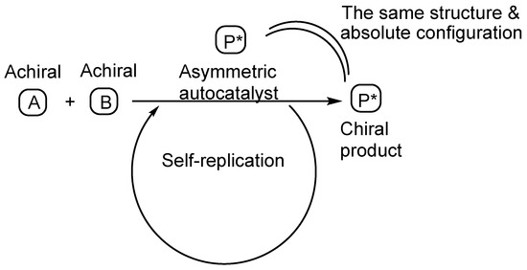
The principle of asymmetric autocatalysis which, if plausible, would provide evidence for the emergence of homochirality in nature.
Kagan and Soai provided experimental evidence for the key mechanisms behind this amplification. In 1986, Kagan showed that the relationship between the amount of one form of a chiral catalyst and the amount of the corresponding form in the product could be non-linear. A small excess of one form of a catalyst could therefore produce a much larger excess of the corresponding form in the product, providing a mechanism for amplifying chirality.
Soai took this idea further. In 1995, he demonstrated an asymmetric autocatalytic reaction in which a chiral product could promote the formation of more of itself. Starting with just a 0.00005% excess of one chiral form, three cycles of the reaction produced more than 99.5% of the corresponding chiral product.
This award recognises the work’s contribution to developing new fundamental tools for generating and amplifying chirality in chemical reactions. These discoveries have also advanced our understanding of one of chemistry’s greatest puzzles: how homochirality, like that found in all living beings, can be created and sustained.
Kenso Soai co-authored a 2019 review, published in Symmetry, that explains the theory of asymmetric autocatalysis and its role in elucidating the origin of homochirality in the chemistry of life. Further reading on homochirality can be found in the Special Issue: Possible Scenarios for Homochirality on Earth.
2026 Nobel Prize in Literature
Anne Carson | For her bold and inventive oeuvre that, in playful dialogue with the classical tradition, has created new forms for contemporary literature
Anne Carson, poet, essayist, translator, and classicist, was awarded the 2026 Nobel Prize in Literature for her distinctive work that unconventionally blends poetry, prose, translation, and scholarship, and challenges traditional boundaries between literary genres. Drawing on her deep knowledge of ancient Greek literature, Carson brings classical myths and philosophical ideas into conversation with modern experiences of love, desire, grief, and identity.

Anne Carson at the 2024 National Book Awards. Jay Dixit /WikiPortraits, Anne Carson, poet, at the 2024 National Book Awards finalist reading 2 (cropped), CC BY-SA 4.0.
Some highlights from her bibliography include:
- Eros the Bittersweet (1986): An essay exploring the nature of romantic desire through ancient Greek poetry and philosophy, combining literacy criticism with poetic insight.
- Autobiography of Red (1998): Written as a ‘novel in verse’, Carson transforms the Greek myth of Geryon, a red-winged monster defeated by Herakles, into an experimental coming-of-age story. The work explores sexuality, vulnerability, and heartbreak through an unusual fusion of myth and contemporary storytelling.
- If Not, Winter: Fragments of Sappho (2002): A translation of the ancient Greek poet Sappho, the earliest female poet in the Western literary tradition. The majority of Sappho’s poetry has been received through fragments, which Carson emphasises by making use of square brackets and broad white space to visually represent missing text throughout.
- Nox (2010): An elegy for Carson’s brother, written through a translation of the Roman poet Catullus. Uniquely, the book is bound as one long sheet of paper which resembles an accordion, and it combines her lyrical style and academic insight to portray a deep sense of loss and grief.
This award recognises Anne Carson’s unique authorship which has blurred boundaries and explored possibilities of writing. She demonstrates a freedom with the way she addresses literary expectations and rule systems throughout her diverse range of creative and academic pieces.
An article published in Humanities dedicates time to discussing Carson’s ability to combine classical ideas with experimental literary forms, using unconventional writing to explore complex human experiences.
2026 Nobel Peace Prize
Navanethem “Navi” Pillay | For her efforts to promote peace and international law
Navi Pillay was awarded the 2026 Nobel Peace Prize for her exceptional courage and integrity which has led the way towards a more comprehensive global legal order. She has been instrumental in ensuring that war crimes, crimes against humanity, and genocide are prosecuted.
Being born into a family of Indian Tamil descent under apartheid in South Africa, Pillay pursued a career in law and became a legal pioneer, confronting deep structural discrimination, segregation, and exclusion.
Having begun her career defending anti-apartheid activists, Pillay went on to become a leading figure in international justice, serving as a judge at the International Criminal Tribunal for Rwanda and the International Criminal Court, as well as United Nations High Commissioner for Human Rights.

An international legal system in which war criminals are held accountable, and victims of abuse see justice is a precondition for a peaceful world. Wayamo Foundation, Navi Pillay, AGJA member and Former United Nations Commissioner for Human Rights (29508439277), CC BY-SA 2.0.
One of her most significant contributions came through the tribunal’s landmark Akayesu case, in which a 1998 judgment established that rape and sexual violence could constitute acts of genocide under certain circumstances. This helped transform the prosecution of sexual violence in conflict and strengthened international recognition of the experiences of victims.
More recently, she chaired a UN commission investigating violations of international law in Gaza. Across her career, Pillay has championed the principle that those responsible for serious international crimes must be held accountable, regardless of their position or power.
This award recognises Navi Pillay’s role as a driving force in the development of an international system of law and order. As we live in a period with a growing number of wars and conflicts, it is important to remember that the resolution of conflicts without force or violence is dependent on the international rule of law.
An article published in Laws discusses how international criminal law has developed its recognition of sexual violence while emphasising the significance of the Akayesu judgement in achieving this.
2026 Sveriges Riksbank Prize in Economic Sciences in Memory of Alfred Nobel
Robert E. Hall and Michael Woodford | For microeconomic foundations of macroeconomic stabilisation
Robert Hall and Michael Woodford have been awarded the 2026 Sveriges Riksbank Prize in economic sciences for research that transformed how economists understand and manage economic fluctuations, demonstrating how economic models could be redesigned to improve policies that keep the economy stable.
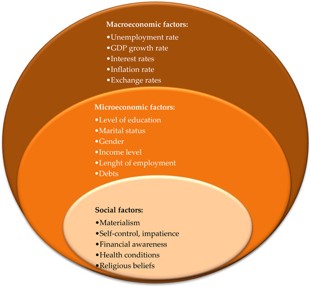
Rather than basing stabilisation models on macroeconomic variables, such as inflation, production, and consumption, Hall and Woodford chose to build them on a microeconomic foundation. Emphasising how the total mass of individual households and businesses affect the economy through their actions.
Governments and central banks use stabilisation policies to reduce economic fluctuations, helping to prevent high unemployment and uncontrolled inflation. However, traditional economic models struggled to predict how the economy would respond to policy changes.
Hall and Woodford helped address this problem by developing the foundations of the New Keynesian paradigm, which builds economic models from the decisions made by individual households and businesses. Rather than relying solely on historical relationships between economic variables, these models account for how people make decisions on their expectations of future income, prices, and interest rates.
Hall demonstrated that changes in household consumption depend on new information that affects expectations about future income. Woodford subsequently incorporated these insights into a broader economic model, showing how central banks could influence economic activity and inflation by adjusting interest rates. His work also highlighted the importance of businesses’ pricing decisions and the expectations that shape them.
This award recognises research that has significantly improved the theoretical foundations of economic policymaking. New models are now used by central banks and finance ministries to assess policy decisions, helping them respond more effectively to economic downturns and the pressures of inflation.
Overall, this year’s prize in economics heavily links economics to psychology, exploring how human cognitive limitations shape economic decisions. A study published in the Open Access journal Risks explores how public perception towards the future changes expectations on inflation which, in turn, have been shown to influence the effectiveness of monetary policy. Using survey data from more than 100,000 people in Japan, this work offers a fresh psychological perspective on economic expectations that also play an important role in policy.
MDPI’s commitment to impactful Open Access research
The discoveries recognised by the Nobel Prizes demonstrate how scientific research can advance knowledge and contribute to addressing global challenges. Open Access publishing helps make these findings available to a wider audience, supporting the exchange of knowledge across the research community.
As an Open Access publisher, MDPI recognises the importance of celebrating scientific excellence. MDPI’s Tu Youyou Award, in honour of the laureate of the 2015 Nobel Prize in Physiology or Medicine, is an international award recognising achievements in natural products chemistry and medicinal chemistry. If you know a researcher whose work deserves recognition, find out how to nominate them here. Nominations close on 31 October 2026.
Discover more scientific discoveries, advances in Open Access publishing and insights into MDPI’s work on the MDPI Blog. You can also explore related research from this year’s Nobel Prize themes across MDPI’s Open Access journals. You can also explore more news from MDPI on the Nobel Prizes here.