


Cleaning Water with Light: The Use of Photocatalysis to Remove Pollutants from Water
Access to safe water is recognised as a vital human right. Yet, in 2024, 2.2 billion people worldwide still lacked access to safely managed drinking water. The importance of addressing this is recognised in the UN’s Sustainable Development Goals (SDG), with SDG 6 aiming to ensure the availability and sustainable management of water and sanitation for all. However, despite initiatives to solve this problem, significant challenges remain.
Drinking water can be contaminated by physical, biological, or chemical substances. Chemical contaminants are especially concerning due to their persistence in the environment and resistance to natural biodegradation, which can lead to their accumulation in water sources. While the long-term health impacts of many of these compounds are largely unknown, exposure has been linked to an elevated risk of various health conditions, including cancer, endocrine disorders, and cardiovascular issues.
These concerns are amplified by the continuous growth of industries, which have intensified the release of hazardous pollutants into the environment.
Conventional approaches to water treatment, such as filtration, chemical treatment, and the use of heat or pressure, can be effective but may require substantial energy to operate and can generate secondary pollution. These limitations highlight the need for more sustainable approaches to water treatment that can effectively remove pollutants while reducing energy use and avoiding the generation of further environmental burdens.
Can the sun’s power be harvested?
A pioneering report in 1972 demonstrated that energy from sunlight could be harvested by semi-conductor materials to drive useful chemical reactions, laying the foundation for the modern field of photocatalysis. Since then, a growing body of research has explored the use of photocatalysis for solar energy conversion and wastewater remediation.
Photocatalytic water treatment offers a promising sustainable alternative to traditional methods, with the potential for low operating costs and complete mineralisation of contaminants into CO₂ and H₂O.
Here, we explore the principles of photocatalytic water treatment and highlight current research aimed at advancing these systems for environmental remediation. With the ultimate goal of translating photocatalytic technologies from laboratory studies to real-world solar-driven applications, these approaches could contribute to more sustainable strategies for addressing water pollution.
Synthetic contaminants with environmental persistence
Synthetic organic molecules, carbon-based compounds, are manufactured for a wide range of industries. There are an estimated 100,000 different synthetic chemicals on the European market, with new compounds being introduced every year. Many of these chemicals are designed to be stable, making them highly effective for their intended purposes. However, these same properties become problematic when they enter the environment, as they can persist for long periods, accumulating over time and posing potential risks to ecosystems and human health.
According to a review article published in the Open Access journal Applied Sciences, several classes of organic pollutants are particularly resistant to degradation and therefore represent major challenges for water treatment technologies:
- Dyes: More than 10,000 commercial dyes are used worldwide, many of which are toxic or carcinogenic.
- Antibiotics: Increasing antibiotic use contributes to environmental contamination and the spread of antibiotic resistance.
- Pesticides: Agricultural runoff can carry pesticides in the environment, where they can harm wildlife and act as endocrine disruptors.
- Microplastics: A major environmental concern, microplastics are highly persistent and threaten aquatic ecosystems and human health.
These pollutants are often difficult to completely remove from water using conventional treatments, driving interest in advanced technologies, such as photocatalysis, to reduce their long-term impact.
Using light to drive chemical reactions
Photocatalysis combines principles of semiconductor chemistry, photochemistry, redox reactions, and radical chemistry to use solar-energy for the generation of highly reactive species that break down persistent pollutants into less harmful products.
A review article published in the Open Access journal Molecules outlines the photocatalytic degradation mechanism (Figure 1):
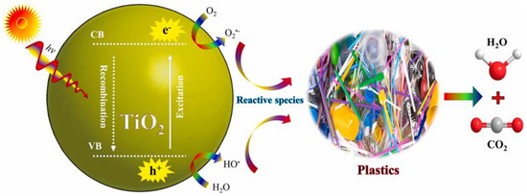
Figure 1: Diagram depicting the mechanism of how semiconductor materials can harness the sun’s energy to drive chemical reactions.
- Photons from sunlight are absorbed by the photocatalyst.
- If the photon energy matches or exceeds the material’s band gap, the intrinsic energy difference between the valence band and conduction band, an electron (e–) is promoted to the conduction band, leaving behind a positively charged hole (h+).
- These charge carriers drive redox reactions at the catalyst surface, where e– reacts with dissolved oxygen and h+ reacts with water.
- These reactions generate reactive oxygen species, which attack and degrade organic pollutants into smaller molecules. Ultimately yielding CO₂, H₂O, and other simple compounds.
Despite its promise, photocatalysis faces several challenges. Many conventional photocatalysts, such as titanium dioxide (TiO₂), have large band gaps and can only utilise UV light, accounting for around 5% of solar energy. In addition, excited electrons often recombine with holes before participating in reactions, reducing efficiency. Slow reaction rates and difficulties associated with catalyst recovery further hinder performance in real-world wastewater treatment systems.
Many of these limitations arise from the intrinsic properties of the photocatalyst, inspiring research into new materials with improved photocatalytic performance.
Alternative semiconductor materials for photocatalysis: ZnO
For many years TiO₂ has been the benchmark photocatalyst for the degradation of organic pollutants. However, researchers are increasingly exploring alternative semiconductor materials that can overcome some of TiO₂’s limitations and improve photocatalytic performance. One of the most promising candidates is zinc oxide (ZnO).
Zinc oxide (ZnO) emerged as one of the first serious alternatives to TiO2 due to its favourable electronic properties and strong photocatalytic activity. Furthermore, sustainable methods for the synthesis of ZnO are emerging. According to a recent review published in Crystals, ZnO offers several advantages that can enhance pollutant degradation efficiency:
- Higher electron mobility, meaning electrons move to the surface faster, enabling faster catalysis and reducing the chance of charge recombination.
- More favourable valence band energetics which promote the formation of reactive oxygen species, specifically hydroxyl radicals.
- Versatile nanostructure formation, which can significantly increase surface area and provide more active sites for catalytic reactions.
These characteristics have positioned ZnO as one of the leading alternatives to conventional TiO2-based photocatalysts.
Improving visible-light activity through doping
Despite its advantages, ZnO still possesses a wide band gap, restricting photocatalytic activity primarily to UV radiation rather than visible light.
Introducing foreign elements (metal or non-metal) to a semiconductor material can modify its electronic properties. Doping can create new energy levels within the band gap, enabling the material to absorb visible light more effectively and reducing charge-carrier recombination.
Recent work published in the Open Access journal Catalysts demonstrated this concept using ZnO doped with aluminium nanoparticles. The doping reduced the ZnO bandgap, which allowed efficient degradation of pyridine using visible light.
Although promising, most systems remain confined to laboratory studies. Further refinement and optimisation will be required before semiconductor-based photocatalysis can be translated into real-world applications.
While ZnO addresses some of the limitations associated with TiO2, researchers are increasingly turning their attention to ferrite-based photocatalysts, which offer additional advantages including visible-light absorption and magnetic recovery. Their magnetic properties allow catalysts to be easily separated from treated water, potentially enabling reuse and supporting more sustainable approaches to environmental remediation.
Next generation photocatalytic materials
While ZnO addresses several limitations associated with semiconductor photocatalysis, including improved charge transport and enhanced photocatalytic efficiency, its relatively wide band gap still restricts the efficient utilisation of visible light.
Consequently, ferrite-based photocatalysts have attracted increasing attention. A recent review in the Open Access journal Applied Sciences highlights that this is primarily due to their narrower band gaps, which enable them to absorb a greater portion of the solar spectrum. This makes ferrites particularly attractive for solar-driven water treatment, while their magnetism can allow catalysts to be readily separated and recycled after use. Together, these properties make ferrites promising candidates for practical wastewater remediation.
The promise of these materials has stimulated extensive research into their ability to degrade organic pollutants under visible light and natural sunlight. One study published in Catalysts reported an environmentally benign route for the synthesis of cerium-manganese ferrite nanocatalysts (Figure 2). These materials degraded two synthetic dyes by over 95% within 90 minutes under visible light.
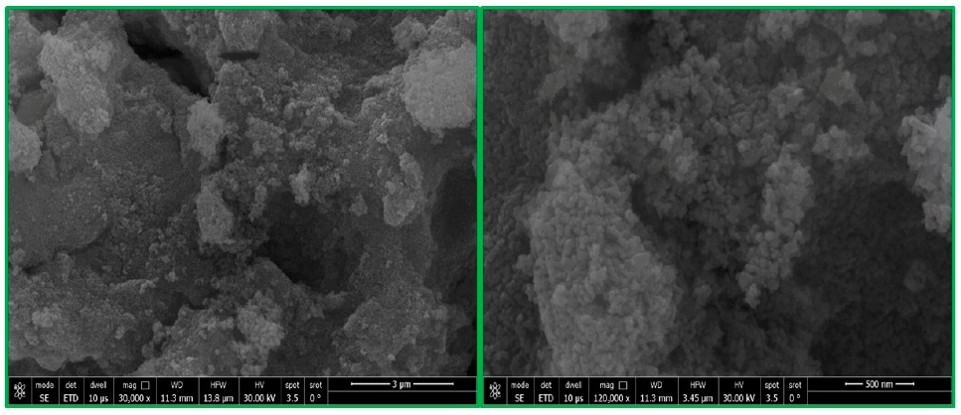
Figure 2: Scanning electron microscopy (SEM) is a technique which allows the characterisation of nanoparticles. The above image shows cerium-manganese nanostructures at 30,000x (left) and 120,000x (right) magnification.
The compositional diversity of ferrites has led to a rapidly expanding body of research exploring their photocatalytic capabilities. Current efforts are largely focused on optimising photocatalytic activity, developing novel material compositions, and improving catalyst stability and recyclability (Figure 3).

Figure 3: Current research focuses on generating materials that can be used effectively and sustainably in wastewater treatment to support efforts in environmental remediation.
Despite these advances, significant challenges remain before ferrite-based photocatalysts can be implemented in real-world wastewater treatment systems. Future research must therefore focus on improving long-term stability, scalability, and performance in complex wastewater environments to bridge the gap between laboratory studies and practical applications.
How Close Is Photocatalysis to Real-World Water Treatment?
A review article published in the Open Access journal Processes, fittingly titled “Is Photocatalysis Ready for Scale Yet?”, examined a decade of techno-economic and life cycle assessment studies and concluded that photocatalysis remains some distance from large-scale implementation.
Despite the promise of photocatalytic systems as a green alternative for wastewater treatment, several challenges remain. These include:
- The sustainability of catalyst production.
- Long-term catalyst durability.
- Efficient recovery and reuse of photocatalytic materials.
Furthermore, a lack of large scale validation continues to represent a significant barrier to commercial deployment.
Nevertheless, continued advances in reactor engineering and sustainable catalyst design suggest that photocatalysis could eventually evolve into a scalable and environmentally sustainable technology for wastewater remediation.
As industrial activity continues to introduce persistent synthetic contaminants into the environment, developing effective methods for their removal is becoming increasingly important. By harnessing energy from the sun, photocatalysis offers the prospect of a clean and sustainable approach to mitigating these challenges, bringing us one step closer to securing safe water across the globe.
Studies on developing new sustainable technologies can be found across the portfolio of MDPI journals covering Chemistry and Materials Science.
Alternatively, you can access the full MDPI journal list here.