
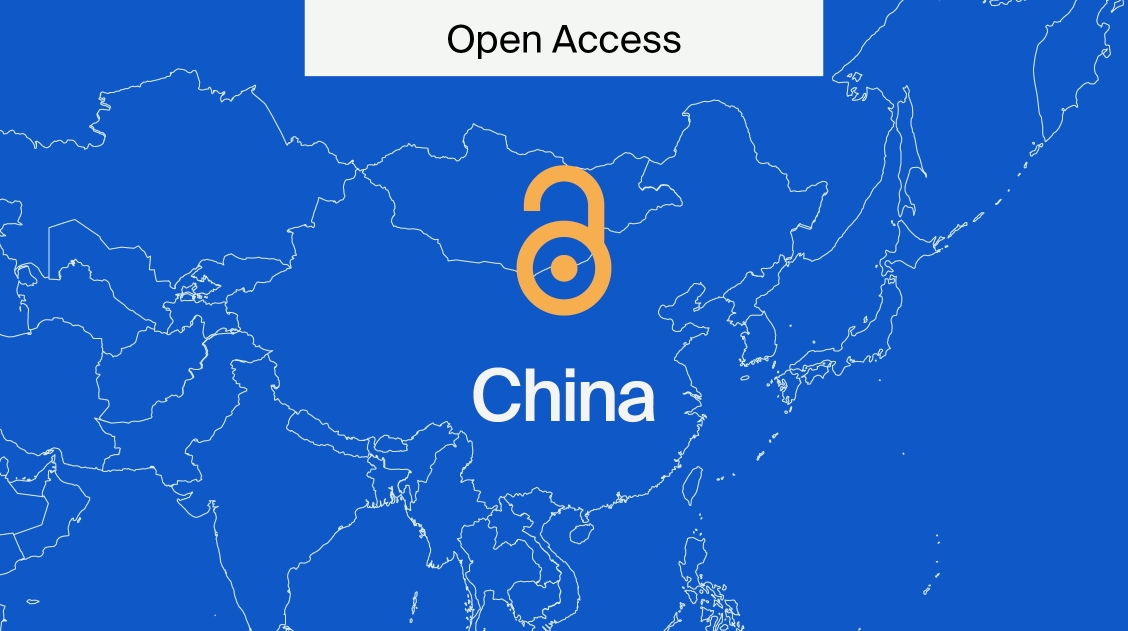
Open Access in China
As the country with the largest output of research articles, China’s approach to open science is shaping global practice. The country’s approach revolves around financially sustainable green Open Access with a focus on international collaboration through critical infrastructure development.
Here, we outline the history of the China’s mandates and its current policies for those looking to submit their research or to read it.
Open Access is the new paradigm
Open Access refers to a publishing model for scholarly research that makes information immediately available to readers at no cost. This research is also often free to reuse for scholarly purposes.
The benefits of publishing Open Access include potentially gaining more citations and therefore having a greater impact, reaching a wider audience, advancing scientific innovation, retaining copyrights, and increasing the potential for collaboration and recognition.
Open Access can also help universities and research institutions in low- and middle-income countries by removing any price barriers to access academic research.
History of Open Access in China
China has actively engaged in international conversations about open science practice and set requirements for researchers to share their work openly. Here is a brief history of Open Access in China:
- 2003: The Center for Science and Technology Development of the Ministry of Education launched the academic preprint exchange platform Sciencepaper Online.
- 2008: The 8thBerlin Conference on Open Access was held in Beijing.
- 2010: The China Open Access Journals (COAJ) platform launches.
- 2014: The Chinese Academy of Sciences (CAS) and Natural Science Foundation of China (NSFC) jointly announce a policy requiring all research produced by scientists at CAS or supported by NSFC grants be archived in Open Access repositories within one year of publication.
- 2015: The Natural Science Foundation of China (NSFC) issue the Implementation Rules of Open Access Policy for Basic Research Repository, launched its basic research repository, and collect the full text of NSFC-funded articles.
- 2016: CAS establish the ChinaXiv repository.
- 2018: Various libraries, such as the National Science and Technology Library, and CAS release a public statement in support of Plan S.
- 2020: Organizations across China signed the Open Access 2020 (OA2020) Initiative.
- 2021: The National Law of Science and Technology Promotion states that open science must be developed.
- 2025: The Action Plan for International Cooperation in Open Science is a Global South-led framework aiming to strengthen open science practice.
Despite early engagement with open science principles and practice, China has not introduced a sweeping policy mandating gold Open Access publication, instead focusing on self-archiving and ensuring there is adequate infrastructure. This likely reflects their approach of balancing long-term Open Access goals with financial sustainability, which is especially important as the output continues to grow.
Furthermore, in recent years, there has been increased engagement with international initiatives such as OA2020 and the Action Plan, indicating that the lack of an updated mandate since 2014 reflects a cautious and considered approach.
Current Open Access laws in China
China has become the world’s biggest producer of research articles, as well as the country with the most cited papers per year. Therefore, their approach to Open Access will drastically influence global practice.
Open Access is taken seriously at a governmental level, with gradual institutional support since the early 2000s and involvement in the creation of the UNESCO 2021 Recommendation on Open Science.
In 2022, the China National Knowledge Infrastructure (CNKI), the country’s largest journal and research database, received criticism regarding its high subscriptions fees, including from CAS. This led to government intervention and an antitrust investigation, resulting in CNKI making its plagiarism-checking services free of charge. Ultimately, this case highlights the focus on long-term financial sustainability in relation to academic research and open science.
Accordingly, the country’s main Open Access policies revolve around green Open Access, as this is considered a very cost-effective method to ensure research is open.
However, there are caveats to focusing on green OA. These include the embargo period for openness, which can delay access to vital research, and lead to there being different versions of articles, as the archived version may be shared before copyediting. Sharing multiple versions is also an issue when it comes to retractions and corrections, as the archived version may not be updated with this information, potentially leading to integrity issues if cited. Finally, archived versions rely on interoperable and functional infrastructure to be discoverable. These caveats are why mandates following Plan S tend to focus on gold OA, as the embargo period is often removed or at least reduced, and the publisher is responsible for ensuring integrity and visibility.
Chinese Academy of Sciences
CAS is China’s leading academic institution and national thinktank in science and technology, as well as the world’s largest research organization. It comprises more than 100 research institutes across China, with each focusing on different research fields and directions.
The 2014 policy requires the following:
Researchers and graduate students to deposit final, peer-reviewed manuscripts of research articles into the open access repositories of their respective institutions within 12 months of their official publication in academic journals.
Researchers that are part of CAS must therefore deposit their final manuscripts in repositories within 12 months of publication.
CAS also has a research library system, the National Science Library of CAS (NSLC). This coordinates resource development and service provision of all institutional libraries in CAS and serves as a national reserve library for information resources.
NSLC provides access to:
- 170+ databases.
- 112,160 Chinese journals.
- 16,000+ journals from outside of China.
- 490,000+ e-books
It is proactively leading efforts to build a national information infrastructure, in line with its commitment to “actively promote open access to knowledge”. This is embodied in the integrated service platform which aggregates all institutional repositories (IRs) from across CAS, known as the CAS IR Grid. The CAS IR Grid covers more than 100 CAS institutes and more than 400,000 papers.
Overall, CAS is committed to advancing knowledge generation and, evidently, ensuring information is openly accessible through robust infrastructure.
Natural Science Foundation of China
The Natural Science Foundation of China (NSFC) administers the National Natural Science Fund and approves research projects. It manages more than 300,000 annual proposals with a pool of 80,000 external reviewers. Alongside this, it funds career development programs, such as the Youth Science Fund and Distinguished Young Scholars, and serves as the interface for international cooperation.
In 2014, in line with CAS, a policy was introduced requiring:
Research papers generated from projects fully or partially funded by NSFC, when submitted and published in academic journals, the authors of the papers should deposit the final manuscripts, which have been peer reviewed and accepted by the journals, to the NSFC repository with an embargo period of no more than 12 months.
Researchers receiving funding from NSFC must deposit their final manuscripts in repositories within 12 months of publication.
In the following year, the NSFC launched a repository to support the implementation of this policy.
China’s Open Access statistics
China has steadily increased its share of Open Access publications over the last ten years, with the percentages approaching an even split. According to InCites data (Clarivate) extracted in July 2026:
- 2014: 72% of articles and reviews were non-OA and 28% were Open Access.
- 2019: 63% of articles and reviews were non-OA and 37% were Open Access.
- 2024: 55% of articles and reviews were non-OA and 45% were Open Access.
Evidently, Open Access is being increasingly engaged with in China, and given the country is the world’s largest producer of research, it is therefore massively increasing the number of open publications that are available.
This increase reflects the successful approach of mandating green OA as well as ensuring there is robust infrastructure.
Future trends
The STM Journal Excellence Plan is a national initiative in Chinese scholarly publishing aiming to place China’s research ecosystem among the world’s top tier by 2035. This revolves around technological transformation, internationalisation, and growing OA activity.
This is demonstrated by China’s recent international collaborations, establishing itself not only as a leader in research but also open science. Examples include the following:
- Action Plan for International Cooperation in Open Science.
- Initiative for International Cooperation on Open Science.
- Open-for-Science 10
These are Global South-focused initiatives, serving to develop shared infrastructures and resources. They position China as a key collaborator and vital driver in establishing critical infrastructure.
China has also expressed support for Plan S and is increasingly collaborating in European initiatives. As China’s output of open publication increases, as well as its overall standing in the global research ecosystem, its role in determining global trends will grow in importance.
These trends will likely differ to how it has manifested in European and North American practice, i.e., primarily through gold OA, given how differently scientific research is structured in China. The system has “three overlapping layers”:
- Legacy hybrid journal system.
- Emerging set of institutionally supported diamond OA incentives.
- A platform-mediated access environment.
With the 2014 CAS and NSFC policies increasing awareness about green OA through self-archiving, China’s approach to Open Access revolves around infrastructure and long-term financial sustainability.
Therefore, there may be more policy developed focusing on green or even diamond OA, as well as infrastructure that functions at an international scale.
Value of Open Access
All articles published by MDPI are made immediately available worldwide under an Open Access license. This means:
- Everyone has free and unlimited access to the full text of all articles published in MDPI journals;
- Everyone is free to re-use the published material if proper accreditation/citation of the original publication is given;
- Open Access publication is supported by the authors’ institutes or research funding agencies by payment of a comparatively low Article Processing Charge (APC) for accepted articles.
Researchers can satisfy China’s developing Open Access policy and pre-empt any stricter legislation by publishing with an MDPI journal. Alternatively, if you want to publish an early version of your article, try Preprints.org, our service for publishing early versions of research that are not peer-reviewed and report on either ongoing or complete research.
Open Access makes vital information accessible to all readers and researchers and brings together scholars from across the world. Thus, it is ideal for tackling global challenges that require urgent and coordinated attention.
China is the world’s biggest producer of articles and is a global leader in open science. Click here if you would also like to learn more about Open Access around the world.