


Insights from MDPI Top Picks: December 2025
In the last monthly roundup of top research published by MDPI in 2025, we explore a variety of articles published in MDPI’s Open Access journals on behalf of reputable societies. This includes the Polish Respiratory Society, Market Access Society, Academic Society for Medical Education, and Spanish Scientific Society for Research and Training in Health Sciences.
In this piece, we learn more about the struggles of getting adequate care for patients with chronic conditions, and the use of ChatGPT to create exam practice questions. We also discover how a visual timer can help students feel less anxious and boost performance during timed examinations, and how a 6-minute walk can be useful to predict the risk of complications after lung surgery.
Patient Perspectives on Health Insurance Design: A Mixed-Methods Analysis
Published in: Journal of Market Access & Health Policy
Research published in the Open Access Journal of Market Access & Health Policy explores insights around insurance policies for people with chronic diseases in the US. People with chronic disease often require specialized treatment and medications, which can be difficult to access even with full insurance policies
Dr. Bridget Doherty, author of the paper, explains the main findings of the study:
“As authors, we wanted to center patient voices in the conversation about value-based insurance reform. We found that:
- 𝟮𝟰% could not afford medications nominally covered by their plan
- 𝟱𝟬% of those earning less than $40K annually could not manage out-of-pocket costs
- 𝟯𝟯% felt financially overwhelmed by insurance costs and 𝟮𝟲% reported frequent stress or anxiety
Qualitative research like this—especially with a patient co-author—offers critical context that complements quantitative data. Numbers tell part of the story, but hearing a patient say out-of-pocket costs meant skipping meals or triggered a stress-induced flare-up truly brings health policy impacts to life.”
Quality Assessment of Pathology Board-Exam-Style MCQs Produced by ChatGPT3.5: A Comparative Study
Published in: International Medical Education
ChatGPT, an AI chatbot that uses large language models, is arguably useful for a wide variety of processes. This includes drafting and translating content, generating images, explaining complex concepts and brainstorming ideas. However the tool has been met with controversy, possibly due to its downsides, such as providing inaccurate information, generating human over-reliance, and its significant energy demands. The chatbot may still be highly advantageous to streamline and simplify processes.
A study published in the journal International Medical Education shows how ChatGPT can be used to generate examination questions for tests like SATs. However, their quality compared to standard study board questions remains unexplored.
To assess the quality of ChatGPT-curated examinations, the researchers compared the quality of pathology-related multiple-choice questions (MCQs) created by ChatGPT and compared these to the commercially available, and sometimes costly, study guide questions for the American Board of Pathology’s certifying exams.
They found that ChatGPT questions were less likely to be accurate compared to study board MCQs, but that they exhibited a higher level of complexity. Therefore, the authors conclude that ChatGPT should not be used to create study guide questions; however, large language models could be used in the future to help create exam study materials.
Time on Their Side: How Visual Timers Affect Anticipatory Anxiety, Performance, and On-Task Behavior in Elementary Math Assessments
Published in: European Journal of Investigation in Health, Psychology and Education
For some students, timed examinations can be a highly stressful environment. This could be due to several different reasons, such as the worry of not being able to complete questions in an allocated time or the importance of the test for their future. These factors may impact overall student performance.
Previous research suggests that having a visual timer present during examinations helps to reduce anxiety and boosts overall performance. A recent study looked at how a visual timer impacted 7- to 9-year-olds on their mathematical performance during a timed assessment.
We hear from Victoire Vallier, an author of the study:
“For many elementary students, the abstract nature of time during assessments creates significant stress and cognitive load. Our study explores a simple, low-cost solution: the visual timer. By testing 7- to 9-year-olds during math exams, we discovered that making time “visible” significantly reduces anticipatory anxiety and curbs off-task behaviors like fidgeting and inattention.”
Crucially, we found these benefits are amplified for children at risk of ADHD, acting as a vital cognitive scaffold. While math scores remained stable, the improvement in student well-being and focus was undeniable. This research urges educators and support professionals to look beyond performance metrics and embrace visual tools that create a fairer, less anxious testing environment for all students.”
Preoperative Six-Minute Walking Distance as a Predictor of Postoperative Complications in Patients Undergoing Lobectomy for Non-Small-Cell Lung Cancer
Published in Advances in Respiratory Medicine
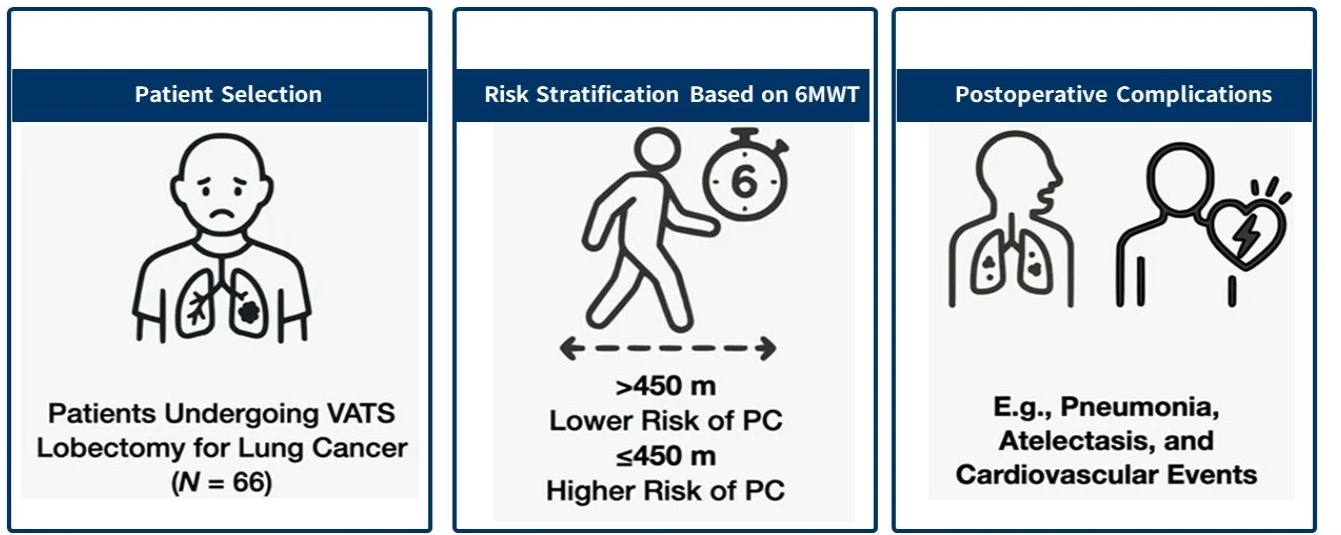
A feature paper published in Advances in Respiratory Medicine shows how a six-minute walk could be used as a predictor of post-operative outcomes for patients undergoing a lobectomy. This procedure entails removing a section of the lung usually by methods such as minimally invasive video-assisted thoracic surgery for conditions like lung cancer, infections and removing benign tumours.
This type of surgery, however, brings the risk of serious complications like pneumonia, which can be fatal especially in older patients with multiple health conditions.
Researchers explored if a 6-minute walk could be an accurate measure of determining postoperative complication risk by analysing 66 patients with non-small cell lung cancer who underwent lobectomies. They found that patients who walked less than 450m in a 6-minute walk test presented with increased odds of postoperative complication such as lung fistula, pneumonia and atelectasis – the collapse of part or the whole of the lung.
These findings could help predict surgical outcomes, guide clinical decisions and aid postoperative rehabilitation.
Learn more about the 23 journals published in partnership with societies. You can also browse the full MDPI journal list, where all research is free and available to read immediately.