
Open Access in Türkiye
Türkiye has a robust infrastructure for Open Access publishing and is gradually increasing its requirements for openness. The country has a range of initiatives designed to support and encourage researchers pursuing open science.
We outline Türkiye’s Open Access requirements and supporting infrastructure for those looking to submit or read research.
Why Open Access?
Open Access refers to a publishing model for scholarly research that makes information immediately available to readers at no cost. This research is also free to reuse for scholarly purposes.
Many researchers are choosing to publish their work in an Open Access format. Governments, funding agencies, and higher education institutions are also mandating Open Access to varying degrees.
In our article 6 Benefits of Open Access, we outline the following:
- Clarity around copyright and licensing ensure that readers know what they can do with work and that they are protected when reusing it.
- Open Access research receives more citations and from more diverse disciplines, institutions, and locations.
- 85% of the world’s population live in low-to-middle-income countries. Open Access ensures that vital information and cutting-edge insights are not limited to countries who can pay to access them.
- Open Access allows people from outside of academia to access research without spending large amounts of resources to access it.
- Open Access enables interdisciplinary research by allowing researchers to focus on common aims rather than be restricted to what’s in their fields.
- Many governments, funders, and higher education institutions are requiring Open Access publication. Satisfying their requirements for publication mean your research can receive the backing it needs.
Current Open Access laws in Türkiye
Türkiye has a robust infrastructure designed to enable researchers to pursue open science.
In 2018, the Turkish parliament mandated that all theses and dissertations must be made openly available. Supported by the Council of Higher Education (YOK), this is achieved by submitting them to the YOK National Theses Center.
TÜBİTAK is responsible for promoting, developing, organizing, conducting, and coordinating research and development in line with national targets and priorities.
In 2019, as the leading agency for the management, funding, and conduct of research, TÜBİTAK introduced an open science policy. This applies to all publications and research data originating from projects carried out or supported by TÜBİTAK.
The policy lists requirements:
- The accepted version of manuscripts must be deposited in the TÜBİTAK Repository.
- The full text of publications must be made Open Access once they are ready for publication, or after a 6–12 embargo period, depending on the discipline.
It also includes some recommendations:
- Choose the gold Open Access route, namely, publish in an Open Access journal.
- Establish research data management plans focused on openness.
- Share data openly.
Furthermore, ANKOS are continually establishing transformative and read and publish agreements with publishers, providing access to research in Türkiye. Their work also includes raising awareness, providing training, and coordinating researchers and institutions.
Open science infrastructure
The Turkish Academic Network and Information Center (ULAKBIM) provides valuable infrastructure and services to support the national science ecosystem.
ULAKBIM services include:
- APERTA: This is the national data repository, ensuring data are findable and accessible.
- HARMAN: This is the Türkiye Academic Archive, which is a national metadata centre, serving as a search engine for national Open Access information.
- DergiPark (Journal Park): This national platform provides online hosting services and an editorial system for academic journals; it hosts many Open Access journals.
In 2026, the Aperta platform was updated to have strengthened infrastructure capacity and an improved user experience.
ULAKBIM works closely with TÜBİTAK to ensure that researchers can follow the mandated requirements for openness.
Diamond Open Access
Diamond Open Access refers to journals which have no article processing charges to submit research and no restrictions to accessing the material published in them.
Because of the strength of Türkiye’s infrastructure, universities can launch and maintain diamond Open Access journals. As a result, in DergiPark, there are around 2500 open journals, with 95% of them being diamond.
This shows the practical benefits of strong infrastructure and national commitment to removing barriers to scientific information.
Educational resources
Also created and hosted by ULAKBIM is the Open Course Platform.
This includes educational resources focused on enabling researchers to develop new strategies and skills relating to open science.
Courses come with certification, and include topics such as:
- Research data management.
- Open Access.
- Responsible Research and Innovation.
- Open Citations.
- Open Peer Review.
- Text and Data Mining.
- Open and Reproducible Research.
This demonstrates that TÜBİTAK and ULAKBIM are invested in supporting researchers in pursuing openness.
OpenAIRE
OpenAIRE has been instrumental in the development of open science infrastructure and practice in Türkiye. The initiative has provided essential infrastructure and fostered collaborations.
OpenAIRE is a non-profit organization, with the mission to promote open scholarship and improve the discoverability, accessibility, shareability, reusability, reproducibility, and monitoring of data-driven research results globally.
It is a European e-infrastructure that offers a diverse set of public services to accelerate the adoption of open principles.
Horizon Europe
Türkiye is a member of Horizon Europe.
Horizon Europe is a European research and innovation commission programme that will last until 2027 and has a budget of €95.5 billion. Its aims are to facilitate collaboration and strengthen the impact of research and innovation in developing, supporting, and implementing EU policies whilst tackling global challenges.
Accordingly, Open Access is mandatory for researchers receiving funding. This is so Horizon Europe can support the “creating and better dispersing of excellent knowledge and technologies”. Its aims revolve around tackling climate change, achieving the UN’s Sustainable Development Goals, and boosting growth.
If you want to learn more about the EU’s Open Access policy, we have a full article on the topic.
Türkiye’s Open Access statistics
Türkiye has gradually shifted towards Open Access publishing, which now represents half of its share of publications. According to InCites data (Clarivate) extracted in September 2026:
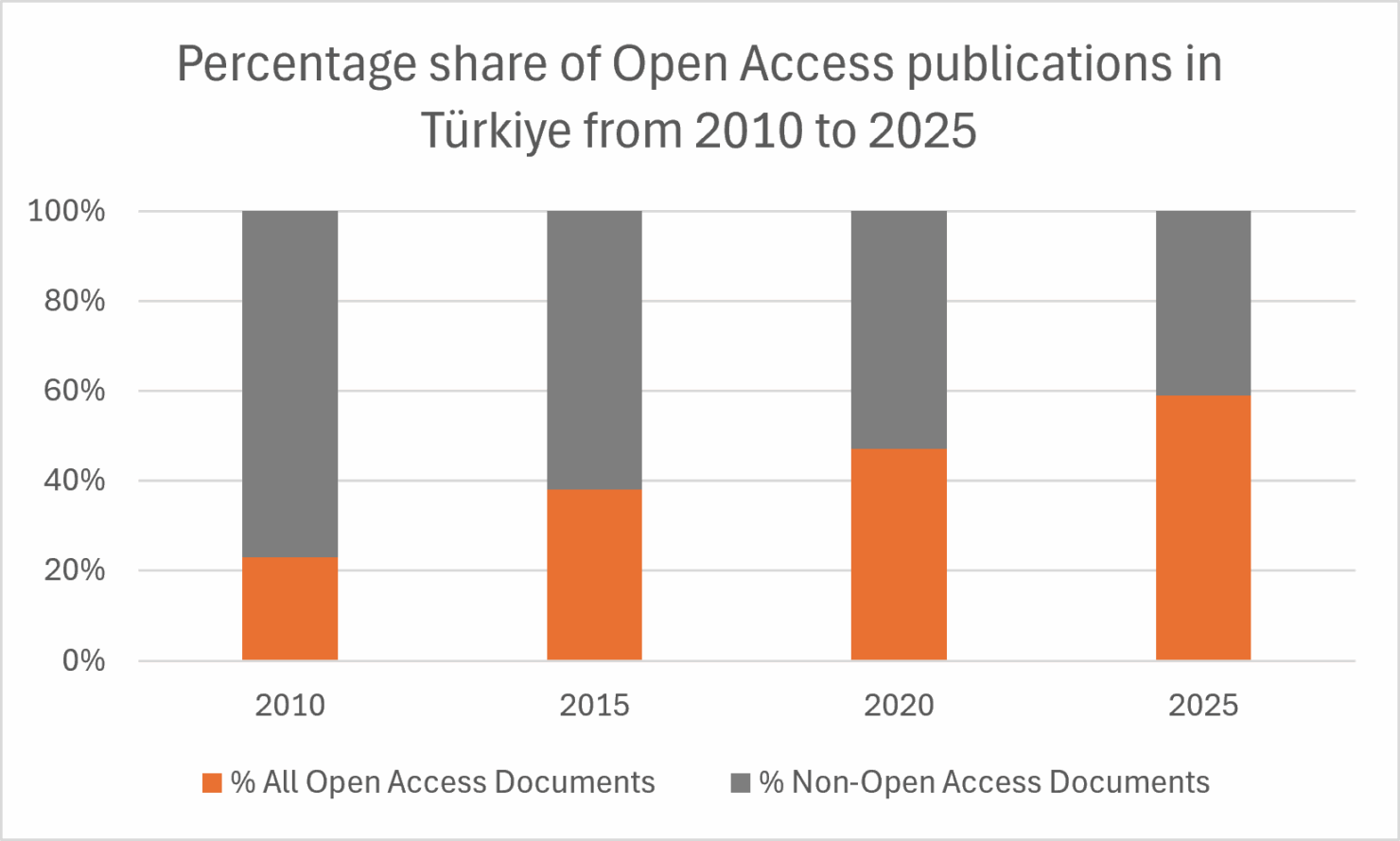
Figure 1: Percentage share of Open Access documents vs non-Open Access documents in Türkiye from 2010 to 2025; data extracted from InCites in September 2026.
As you can see, there has been a steady decline in non-OA publications in Türkiye, with more researchers choosing Open Access. The robust system of infrastructure in the country has made choosing openness a reliable option for researchers even before mandates were introduced.
Future trends
Türkiye has seen a steady increase in open science practices, which is being supported by highly developed infrastructure and policies.
The TÜBİTAK policy contains requirements, namely, sharing the publication openly, and recommendations that researchers share their data openly. In line with evolving open science practices globally, TÜBİTAK could begin to mandate open data, much like IZTECH already have.
This would involve a greater emphasis on open data and data management plans.
Furthermore, the country’s longstanding collaboration with OpenAIRE is likely to continue, encouraging collaboration and infrastructure development.
The suite of ULAKBIM services remains a vital resource for researchers in the country, which only reflects their commitment to ensuring open science.
In short, Türkiye’s robust infrastructure for open science and its growing share of Open Access output reflects its commitment to ensuring research is openly available to all.
A global leader in Open Access publishing
For more than 30 years, MDPI has been built on the conviction that scientific knowledge should be shared immediately and freely with everyone.
Read what authors from Turkish institutions who have published in MDPI journals have to say about their experience publishing with MDPI:
“I had a highly positive experience publishing with MDPI. The editorial and peer review process was professional, efficient, and constructive, and the submission platform facilitated a smooth workflow.” – Dr. Saliha Çelik, Osmaniye Korkut Ata University, Türkiye, author published in Sustainability.
“I appreciated the fast publication timeline and the clear communication. Overall, MDPI provides an excellent platform for researchers to share their work, and I would be glad to publish with MDPI again in the future.” – Dr. Mine Doğan, Firat University, Türkiye, author published in Mathematical and Computational Applications.
“The editorial process was fast, efficient, and well-organized. The reviewers provided constructive feedback, and the entire publication experience was smooth and professional. I appreciate the journal’s commitment to maintaining high academic standards and would highly recommend it to researchers in the field.” – Prof. Dr. Gülay Kaçar, Bolu Abant İzzet Baysal University, Türkiye, author published in Insects.
MDPI gives readers free and unlimited access to the full text of all published articles. It has more than 500 journals dedicated to providing the latest findings, many of which publish interdisciplinary research. If you are interested in submitting your work, see the full list of journals here.
Alternatively, if you want to publish an early version of your article, try Preprints.org, MDPI’s service for publishing early versions of research that are not peer reviewed and report on either ongoing or complete research.
Understanding Open Access policies
Navigating policies can be time-consuming and detract from time spent researching. However, understanding them is important as there may be penalties for not complying with publication requirements.
To support researchers, the MDPI Blog publishes a series of articles outlining different countries’ relationships with OA, exploring their histories, current policies, opportunities, and statistics. All this information is centralised into an article which contains brief summaries of each country, with links to all the full articles, and is updated monthly.
Click here if you would also like to learn more about Open Access around the world.
This article was last updated in September 2026.