
How Hidden DNA Switches Shape Honeybee Society
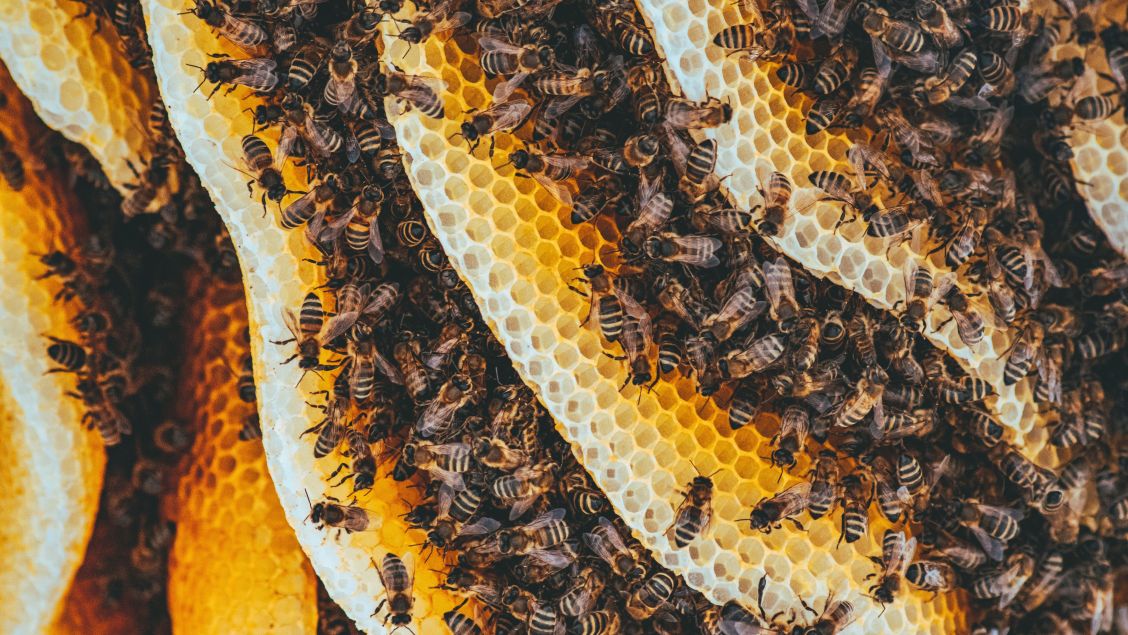
Honeybees, and many other insect species, exhibit a form of social organisation in which individuals specialise in different tasks, such as foraging, nest building, defending the colony, and caring for the young. This system, known as eusociality, allows colonies to operate more efficiently and greatly increases their chances of survival.
Worker bees represent one of nature’s most extreme examples of altruism, they are sterile and sacrifice their direct reproduction to care for the queen’s offspring. As larvae, worker bees and queen bees begin life with almost identical DNA. Despite sharing the same genetic information, they develop into individuals with dramatically different appearances, behaviours and reproductive abilities.
These fascinating societal characteristics are thought to be driven by differences in gene regulation. This includes when, where, and how strongly certain genes are activated during development. Understanding this aspect of gene regulation is key to explaining how genetically similar individuals develop into such distinct castes.
A new study published in the Open Access journal Insects has investigated these hidden genetic switches during honeybee development. Using a technique called cap analysis of gene expression (CAGE) researchers have been able to identify active regulatory elements throughout the metamorphosis of worker bees for the first time. These findings have provided a new insight into the molecular mechanisms that help to create one of nature’s most sophisticated social systems.
Professor Hidemasa Bono, lead author of the study, explains:
“Our study asks which enhancers are actually active during honeybee worker metamorphosis and which transcription factors use them to regulate key developmental genes.”
Enhancer DNA: The hidden switches in the genome
The genetic code of an organism is a long sequence of code that can be thought of as an instruction manual for an organism’s development. Some of this code is used to express proteins which can cause an organism to display certain characteristics, whereas other regions are non-coding, parts of which are responsible for controlling when and where genes are turned on or off. Among the most important of these regulatory regions are enhancers.
How enhancers work is still unclear. Rather than acting as an on/off switch, they are thought to act as a dial that can influence how strongly a nearby gene is expressed. This ensures that genes are only activated in the appropriate tissues and at the correct stages of development.
Enhancer regions can bind proteins known as activator proteins which aid the recruitment of additional proteins that are needed to begin gene expression. Interestingly, these enhancer sequences are often located thousands of base pairs away from the genes they act on and therefore rely heavily on the three-dimensional folding of the genome to be effective.
Identifying the DNA sequences responsible for controlling these genes throughout development has proven difficult as these regions of DNA do not produce proteins themselves. Many regulatory regions have only been predicted using computational analyses rather than being observed directly.
When enhancer regions of DNA are active, small fragments of enhancer RNA (eRNA) are produced which are notoriously difficult to capture. CAGE is a genomic sequencing technique that can overcome this limitation and detect which enhancer regions are active and when.
The researchers in this study used CAGE to identify which enhancers are active during the metamorphosis of worker bees in Apis. Mellifera. Rather than relying solely on predictions, this analysis allows scientists to observe gene regulation in real time as development unfolds.
Professor Hidemasa Bono highlights the importance of this study:
“Previous studies predicted transcription factor binding sites computationally from genome sequence alone, and direct evidence of activated enhancers across sequential developmental stages in worker bees has been lacking”
Following bee development
This study focuses on the changes in bee genes during worker metamorphosis, the developmental period during which a larva transforms into an adult worker bee. This period reflects one of the most drastic changes in the species life as tissues are remodelled, organs mature, and many new types of cells start to form. To complete this process, thousands of genes need to be precisely coordinated and controlled.
To investigate this process, the researchers collected honeybee workers at several developmental stages spanning larvae, prepupae and pupae. Using CAGE sequencing, they mapped regions of active gene expression throughout metamorphosis.
Analysis revealed 842 active enhancer genes which the researchers highlighted could be responsible for tissue-specific expression of genes in worker bee metamorphosis. It was noted that enhancers displayed distinct patterns of activity across stages of development, which suggests that different gene regulation mechanisms may come into play as metamorphosis progresses.
To better understand these changes, the researchers grouped genes according to their patterns of expression throughout development. This revealed five major developmental clusters, with each cluster representing genes that became active at similar stages of metamorphosis. These clusters were associated with different biological processes, including:
- Cuticle formation
- Lipid metabolism
- Nervous system development
- Muscle assembly
All these processes are essential for transforming a larva into an adult work bee.
By grouping genes in this way, the researchers were able to identify which developmental processes were occurring at different stages of metamorphosis and link them to specific patterns of gene regulation.
The transcription factors behind development
The researchers went beyond identifying what enhancers were turned on and when. They also investigated what was responsible for activating the enhancers. This was done by looking at transcription factors, the proteins that bind to DNA to control whether nearby genes are expressed or not.
The researchers used computational methods to compare patterns of enhancer activity with patterns of gene expression. They also searched the enhancer DNA for short sequences known to be recognised by specific transcription factors. By combining these pieces of information, they predicted 15 regulatory networks in which a transcription factor binds to an enhancer and controls the activity of a nearby gene.
One transcription factor, called tramtrack (ttk), appeared particularly important. Binding sites for ttk were found in several active enhancers, including those linked to Broad-complex (Br-c), a gene known to play a central role in insect metamorphosis. Because Br-c controls many of the genetic changes needed for a larva to develop into an adult bee, discovering that ttk may regulate Br-c provides an important clue about how this developmental process is controlled.
The researchers then asked whether these ttk binding sites were shared across different bee species. They found that the DNA sequences recognised by ttk were almost perfectly conserved only within the Apis genus, which includes the western honeybee. This suggests that although all bees undergo metamorphosis, the precise genetic mechanisms controlling the process may have evolved differently amongst different species.
These findings are currently predictions based on gene activity and DNA sequence analysis, so further laboratory experiments will be needed to confirm them. Nevertheless, the study represents an important step towards understanding not just which genes are involved in development, but how they work together as part of a larger regulatory network to produce the specialised worker bee.
What honeybees can teach us about the secrets of our DNA
This study improves understanding of how gene regulation shapes one of the most complex social systems in the animal kingdom. By applying CAGE technology throughout honeybee metamorphosis, researchers produced the first genome-wide map of active enhancers during worker developmental stages, identifying hundreds of regulatory DNA regions and uncovering potential networks controlling key developmental genes.
Beyond honeybees, these findings contribute to understanding how organisms with the same DNA develop into such different forms. Scientists increasingly recognise that many evolutionary innovations arise through changes in how existing genes are regulated. Small changes in regulatory DNA can have major effects on development, behaviour and physiology without altering the genes themselves.
Although this research focuses on honeybees, the principles can be applied across many animals, including humans. Technologies such as CAGE are already helping researchers investigate how enhancers control human development and how disruptions to these regulatory elements contribute to developmental disorders. By understanding how regulatory DNA functions in model organisms like honeybees, scientists can refine the tools and approaches needed to study complex genetic regulation in other species.
Ultimately, this work reminds us that the presence of genes only reveals so much. Hidden throughout the genome are thousands of molecular switches that determine when genes are turned on and off, shaping everything from the development of a worker bee to the formation of tissues in the human body. As researchers continue to uncover these hidden regulatory networks, studies like this bring us one step closer to understanding not only how complex societies evolve, but also how life itself is controlled at the molecular level.
More studies on insect metamorphosis and gene regulation can be found across the Open Access journals Genes and Insects. Alternatively, you can access the full MDPI journal list here.