

Interview with our Specialist Editor: Providing Subject-Specific Expertise
Academic editing is a high-level service that goes deeper than standard proofreading and language editing services. It provides subject-specific expertise and in-depth technical refinement during the manuscript preparation phase, helping to improve the scientific content and structure of the paper as the author is guided from pre- to post-publication.
To provide further insight into MDPI Author Services and its dedicated academic editing service, we sat down with Dr. Jemima Jobling to discuss what reviewers look for in a manuscript, common mistakes, the importance of precision, and the benefits of specialist editing for authors.

Can you briefly describe yourself, your academic background and research field?
My name is Dr. Jemima Jobling, and I’ve been a Quality Control Coordinator in the Author Services department at MDPI for over 2 years. I hold both an MA and an MPhil from the University of Cambridge, and earned my PhD in French literature at Newcastle University in 2022. My research focus also encompassed philosophy, sociology, and gender and queer studies. In my spare time, I am an avid crocheter and knitter!
From your experience, what do reviewers pay attention to first when assessing a manuscript?
When presented with a manuscript, I initially look at the strength of the Abstract. Does the Abstract clearly outline the study at hand? Are the study’s motivations, outcomes, and structure sufficiently signposted? Can a reader quickly identify the manuscript’s contribution to knowledge?
A clear, concise Abstract sets the stage for your study, and is one of the first indicators—for reviewers and readers alike—that the findings presented are valuable, relevant, and well–researched.
What is one common mistake people make with manuscript preparation? And how might resolving common mistakes lead to stronger and more accessible research?
As a Specialist Editor, one of the most common issues I see in manuscripts is a lack of appropriate signposting. For maximum impact and accessibility, it is important that authors guide their readers from one section to the next. It is also best practice to outline in the introductory sections how, precisely, the research will be presented and structured. While seemingly small, such inclusions can really help in communicating your research effectively and making it accessible to as wide an audience as possible.
Which part of a manuscript do authors often underestimate during preparation, but reviewers examine closely? Or how important is subject-specific terminology and precision in convincing reviewers?
I would say that the methodological sections are those that are most often overlooked or rushed. Even with more qualitative research, it is vital that readers are able to clearly understand how the study was conducted, what steps were taken, and the reasoning for the theoretical or analytical approaches employed. Reviewers will also be on the lookout for appropriate references and citations; these should be up-to-date, relevant, and clearly marked for maximum professionalism and impact.
While subject-specific language should not be used excessively, it is nevertheless important that authors employ accurate, field-specific terminology when presenting their findings; this not only indicates their expertise, but also helps improve searchability, ensuring that their research reaches the right audiences.
How can Specialist Editing help authors address these issues before submitting their manuscript?
As Specialist Editors, our job is to identify areas for improvement before manuscript submission. We look for the kinds of issues I have flagged here: insufficient or inaccurately cited references, a lack of clarity or poor structure, and inappropriate use of specialist terminology. We provide feedback on all of the above and more, reading through manuscripts section by section and drawing on our academic expertise and industry knowledge to advise where improvements can be made.
Looking ahead, what do you think reviewers will expect more of from manuscripts at the initial submission stage?
With the accelerating incorporation of AI functions into industry, academia and beyond, I imagine that the inclusion of appropriate keywords and field-specific terminology will become increasingly important. As ever, it is crucial that authors ensure that any such language or key terms are spelled and presented accurately.
Are you a researcher looking to benefit from high-quality specialist editing by PhD specialists in your field? The service offers a comprehensive, subject-expert review that goes beyond simple language editing to strengthen structure, clarity, and technical accuracy, helping researchers submit with confidence.
By choosing the Author Services “Academic” editing service, on top of receving regular editing ensuring clear expression, consistent terminology, and correct grammar, authors additionally benefit from:
- Three language experts and a subject specialist working on your paper (4 rounds of edting in total)
- A technical review report with actionable feedback
- Free cover letter and reviewer response editing
- 50% off figure and table editing
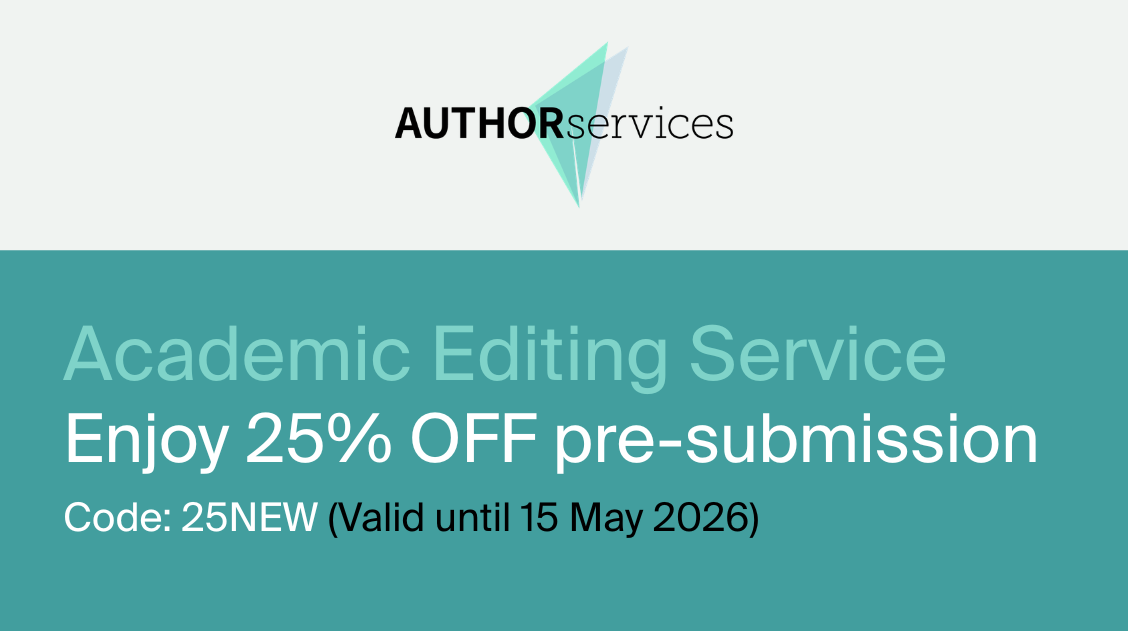
As part of the ongoing Author Services academic campaign, authors can also receive 25% off pre-submission when selecting the “Academic” editing service. Start your order today and give your paper the best chance of publication.