
Low-Dose Insecticides Can Change How Ant Colonies Behave
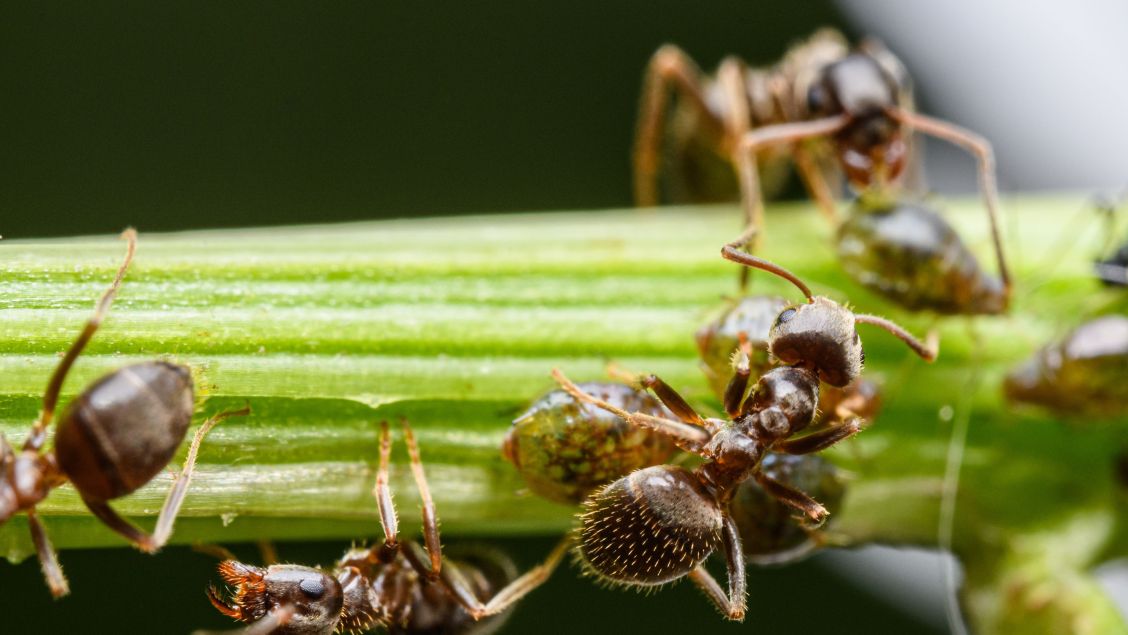
Argentine ants (Linepithema humile) are an invasive pest found across the world. Their adaptability, competitive behaviour, and tendency to form supercolonies can lead to the displacement of native insect species. This can contribute to declines in biodiversity and disrupt natural ecosystems in invaded habitats.
Toxic baits are widely used to manage argentine ants. These baits are shared across ant colonies by worker ants through trophallaxis, the mechanism by which individual insects perform fluid exchange. This allows the active ingredient to spread throughout the colony.
However, because the bait becomes diluted as it is shared, many ants may be exposed to amounts that do not immediately kill them but can still affect their behaviour. Understanding these sublethal effects could help explain how ant activity changes after baiting and has the potential to influence how manufacturers formulate ant baits.
A new study published in the Open Access journal Insects investigated how two commonly used bait toxicants, boric acid and thiamethoxam, affect argentine ants at low concentrations. The researchers found that the two compounds produced very different behavioural responses. Boric acid caused ants to cluster inside their nests and reduced their activity outside, while thiamethoxam caused ants to leave the nest and become more active in the foraging area.
Dr. Dong-Hwan Choe, corresponding author on the study, states:
Though these treatments don’t work immediately, you can see by the ants’ behaviour that they’re affected.
How do toxic baits affect ant colonies?
Liquid baits are commonly used to control argentine ant populations because insects readily consume sugary solutions. For a bait to work effectively, the toxicant should remain soluble in water and act slowly enough for ants to carry it back to its nest to share it with the colony.
Most previous studies assess bait effectiveness by measuring mortality or changes in foraging activity. However, there being fewer ants outside the nest does not necessarily correlate with more deaths and may reflect a shift in the behaviour of the insects.
Therefore, the researchers exposed laboratory colonies of argentine ants to sucrose water containing either 0.2% boric acid or 0.00005% thiamethoxam. These concentrations were chosen to produce behavioural effects while causing little morality during the experiment.
The team monitored how many ants were inside the nest and how many were in the foraging area over three days. They also tested individual ants in an arena containing light and dark areas to see whether the treatments affected their movements or responses to light.
Boric acid caused ants to cluster inside the nest
Following exposure to boric acid, ants became increasingly concentrated inside their nest. By days 2 and 3, the density of ants within the nest was significantly higher than before treatment.
At the same time, fewer ants were found in the foraging area. Overall, boric acid increased the density of ants inside the nest by 25.6% and reduced activity outside the nest by 56.3%; this was compared to the control group where no change in ant density was observed.
The researchers suggest this behaviour could be related to the physiological effects of boric acid. The compound can damage parts of the digestive and excretory systems in insects and may interfere with water regulation, potentially encouraging ants to remain close to conserve water inside the nest.
However, the study did not directly test whether water regulation caused the observed behaviour, so other effects of boric acid may also be involved.
Thiamethoxam had the opposite effect
Thiamethoxam produced almost the reverse response.
Instead of clustering inside the nest, treated ants became increasingly concentrated outside it. The number and density of ants inside the nest decreased, while the number in the foraging area increased.
Overall, thiamethoxam reduced in-nest density by 36.5% and increased out-nest activity by 862.3%.
Mechanistically, thiamethoxam is a neonicotinoid insecticide that acts on receptors in the insect’s nervous system. Previous research has linked neonicotinoids with changes in activity and other behaviours in ants and other insects, including neuronal overstimulation.
In this study, the treated ants continued moving around the foraging area rather than returning to the nest. This increased activity was observed despite the fact that the ants were exposed to a concentration that caused little mortality during the experimental period.
Dr. Dong-Hwan Choe explains the observations:
It’s like [the ants] are all high on nicotine, their nervous systems have been compromised by the insecticide.
Importantly, an increase in the number of ants outside the nest could be interpreted as an increase in infestation, even though it may instead reflect a behavioural response to the bait.
Changes in ants’ response to light may explain changes in behaviour
Three days after the application of insecticide, individual ants were placed in a behavioural arena and their movement was tracked for 10 minutes. Surprisingly, neither boric acid nor thiamethoxam significantly changed the total distance travelled. Ants from all three groups, including the control group, travelled similar distances, averaging between 819 and 848 cm.
This suggests that the major differences observed at the colony level were not simply caused by the ants becoming more or less capable of movement.
However, when assessing how the ants responded to light, the two pesticides produced different effects. Ants treated with thiamethoxam spent significantly more time in illuminated areas than control ants, with an average time of 313.5 seconds compared to 264.7 seconds.
The researchers suggest that thiamethoxam may disrupt the normal light-avoidance behaviour seen in ants, consistent with previous studies of the insecticide performed on bees. This change in behaviour could contribute to the wandering behaviour observed in treated colonies.
How the behavioural changes could be useful to pest management
These findings suggest that the effects of an insecticide can be more complicated than simply killing the insects that consume it.
For boric acid, a reduction in foraging activity could make the bait seem effective soon after treatment because fewer ants are visible outside the nest. This insight could help explain why some field studies have observed a brief recovery in ant recovery after boric acid baiting. The initial behavioural response of clustering inside the nest could cause the ants to potentially avoid any further exposure and later return to foraging. However, other factors, such as new colonies moving to the area or the emergence of new workers could also contribute to a recovery in activity.
On the other hand, thiamethoxam baiting was seen to increase ant activity in foraging areas. This behavioural change of affected ants meant they were still capable of consuming the bait solution. This raises the possibility that increased activity could contribute to further bait consumption and toxicant transfer within the colony.
At the same time, increased wandering could potentially move infected ants into new areas. In practical pest management, the increased activity of affected ants in well-lit locations could lead to an unintended spread with the possibility of infestations at different sites.
This information could be useful for pest management professionals, helping them advise customers to check and treat potential entry points around doors and windows to prevent affected ants from spreading into new areas.
A study to inform future strategies for managing ant infestations
This study highlights why mortality alone may not provide the full picture of how insecticidal bait affects social insects.
Argentine ant colonies are organised systems in which individual behaviour can influence how food, water, and toxicants move through the colony. A compound that causes ants to remain inside the nest could have very different consequences from one that causes them to leave it, even if both are ultimately lethal.
The researchers state that these behavioural effects could be considered when evaluating bait products and interpreting changes in ant activity following treatment.
However, further work is still needed: the study only followed the colonies for three days after exposure, so it remains unclear how long the behavioural changes persist. Future experiments could determine whether the effects become stronger, disappear over time, or whether some treated ants recover and return to normal activity.
It would also be useful to investigate how other commonly used ant toxicants affect behaviour, as well as whether combinations of compounds such as boric acid and thiamethoxam produce different effects.
By looking beyond mortality, researchers may gain a clearer understanding of how insecticides alter the behaviour and organisation of pest colonies. For argentine ants, this could help explain changes in activity following baiting and provide information that can be used to refine future pest management approaches.
More research on insect behaviour, pest management, and entomology can be found across MDPI’s Open Access journals Agronomy, Agriculture, and Insects.
Alternatively, you can access the full MDPI journal list here.