

Insights into MDPI Top Picks: October 2026
October has seen a range of exciting research published across MDPI’s Open Access journals.
In this roundup, we showcase:
- Recent advances in pesticide monitoring that highlight the importance of monitoring non-approved compounds.
- How bio-inspired soft robotics could be used to create new types of manufacturing machinery.
- An exploration into of the role of geological mapping in the colonisation of Africa.
- The use of mycelium-based composites as replacements for petroleum- and foam-based packaging.
A Snapshot of Pesticide Residues in Human, Animal, and Environmental Samples Across 10 European Countries
Published in Environments, September 2026 | Department of Public Health, Aarhus University
Pesticides are compounds designed to kill or repel organisms that are considered pests. They are widely used in conventional farming to increase crop yields. However, some pesticides and their metabolites can persist in the environment and move beyond the areas where they are applied, contributing to contamination of surrounding ecosystems.
Many approved pesticides display toxicity to non-target species, including animals and humans. This is reflected in the hazard classes introduced by The EC Delegated Regulation in 2023. The adverse effects of certain classes of pesticides are well established, this includes:
- Acute and chronic neurological diseases and neuropsychological disorders.
- Cancer
- Respiratory diseases
- Endocrine disorders
- Reproductive health effects
More cohesive pesticide monitoring would provide a comprehensive understanding of occurrence and exposure pathways. The European Sustainable Plant Protection Transition (SPRINT) project was designed to address this need.
As a part of the SPRINT project, researchers from institutions across Europe assessed 224 pesticide residues across a total of 16 human, animal, and environmental sample types collected during the 2021 growing season at 10 European sites. Human samples included plasma, urine, faeces and silicone wristbands worn by farmers, nearby residents and consumers. They also analysed samples from six animal species and livestock feed, alongside environmental samples including soil, earthworms, crops, water, sediment, outdoor air and dust, and farmhouse dust.
Both approved and non-approved pesticides were found across human, animal and environmental samples, demonstrating that pesticides can be found beyond the fields where they are applied. Further, non-approved compounds accounted for 10–70% of the residues among the ten most frequently detected compounds in different sample types, while the banned pesticide DDT’s persistent metabolite p,p’-DDE was detected in 11 of the 16 sample types.
The study highlights the need for future pesticide monitoring programs to consider non-approved compounds alongside approved ones when assessing exposure and potential risks. It also illustrates how human, animal and environmental exposure are interconnected, supporting a One Health approach to investigating pesticide contamination.
Read more about how microbial inoculants offer a sustainable option to improve soil health in Engineering the Underground: How Microbial Inoculants Provide Sustainable Agriculture Alternatives.
Bioinspired Soft Modular Robotic Cubes as Building Blocks for Adaptive Machines
Published in Robotics,, October 2026 | Department of Mechanical Engineering, Universidad de Chile
Worms, octopi, and jellyfish rely on soft, deformable tissues rather than rigid skeletons to achieve efficient movement. These natural strategies have inspired the growing field of bioinspired soft robotics.
Pneumatic soft robots mimic muscle tissue, using pressurised air to drive the expansion and contraction of soft actuators. Modularity provides a further bioinspired principle, allowing individual actuators to work together to produce more complex movements. However, existing modular systems often use identical units, limiting the range of movements to just one type of movement. Researchers from Chile aimed to develop a robot containing a heterogenous collection of modules that was capable of more complex motions, Juan Zagal, lead author of the study, explains the approach:
“We explore this possibility by developing a family of soft, pneumatically actuated building blocks capable of producing different types of motion, including linear displacement, rotation, bending, expansion, and shear.”
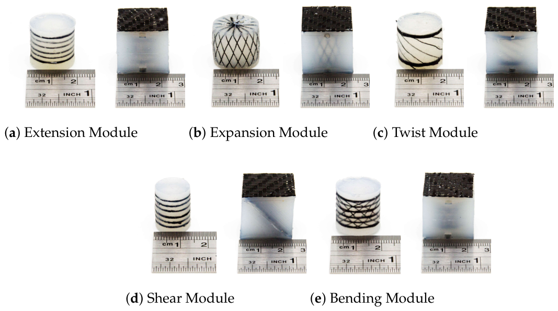
Each designed module consists of a deformable elastomeric cube with an embedded fiber network that guides deformation during inflation. The internal fiber networks are shown here alongside the movement they are designed for.
The researchers designed and modelled five bioinspired soft robotic cubes, each producing a different type of movement. To the best of the authors knowledge the shear module is the first of its kind to prioritise planar displacement as its primary motion.
The shear and extension modules were assembled into a Cartesian platform. The resulting system demonstrated coordinated movement along three axes. Juan Zagal explains:
“By combining these modules, we demonstrate a functional Cartesian robotic platform capable of coordinated motion along three axes. This is particularly interesting because Cartesian positioning systems are at the heart of many manufacturing machines, including 3D printers and CNC milling machines.”
Precision, stiffness, and control remain challenges for practical manufacturing applications. Nevertheless, the work suggests a future in which soft robots could become part of the machinery used to manufacture products. As Zagal highlights:
“Soft robots might not only be products of manufacturing technology but could eventually become part of the machinery that performs manufacturing itself. In future work, we hope to continue exploring this direction, bringing soft robotics closer to practical machines and applications.”
Behind the Scenes: The ‘Angolan Geological Mission’ (1921–1926) and the Geological Mapping of Africa
Published in Geosciences, September 2026 | HTC—History, Territories and Communities, Centre for Functional Ecology, University of Coimbra
Maps transform complex geographical data into practical knowledge, informing fields such as urban planning, disaster management, resource management, and public health. Yet throughout history, maps may have also been produced with other intentions in mind, beyond the geographical information they display.
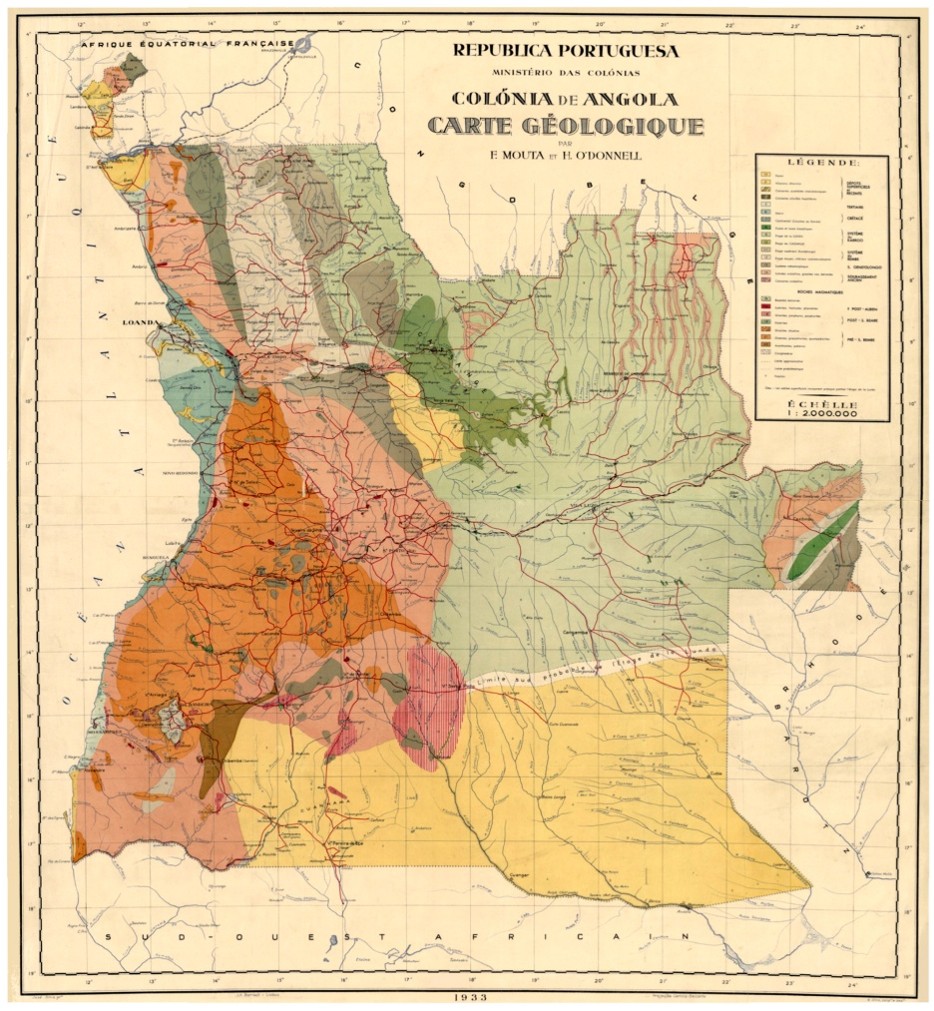
Geological map of Angola by Mouta and O’Donnell, 1933 (1:2,000,000).
The Geological Mission of Angola (1922-1926) illustrates how scientific exploration could serve both geological research and colonial interests. The mission collected thousands of rock and fossil samples while documenting geological features that contributed to the first Geological Map of Angola.
Drawing on archival documents, historical maps, geological samples, and scientific reports, the authors examine the mission’s contribution to geological science. The mission’s findings informed international geological research, while its collections were transferred to museums in Lisbon and local communities remained largely absent from the historical record. Furthermore, surveys throughout the mission helped identify and document mineral resources and their distribution to support future resource extraction.
Interestingly, this piece highlights the contradiction between the scientific value of many geological surveys of colonial Africa alongside their role in serving the colonial interest. The authors argue that the mission’s scientific contributions must be considered alongside its role in advancing Portugal’s colonial ambitions and facilitating the exploitation of Angola’s natural resources.
Bio-Composite Progress (Part A): Advances in Mycelium-Based Composites as Sustainable Alternatives to Plastic and Foam Packaging
Published in Polymers, September 2026 | Department of Biology, Faculty of Science, Chiang Mai University
The rapid expansion of retail and online shopping has significantly increased the demand for packaging materials. However, conventional petroleum-based plastics and foams place a significant burden on the environment due to their persistence and resistance to degradation.
Mycelium-based composites (MBCs) form when fungal hyphae bind agricultural residues into lightweight, stable, and biodegradable materials. This approach transforms agricultural waste into value-added products, aligning with circular economy principles while offering more sustainable packaging.
Researchers in Thailand developed mycelium-based cushioning packaging (MBCP) from the grey oyster mushroom (Lentinus sajor-caju). They cultivated the substrate on four abundant biomass residues (corn husk, rice straw, sawdust, and sugarcane leaves) and comprehensively evaluated their resulting physical, mechanical, structural, biodegradation, phytotoxicity, and cushioning performances.
Sawdust-based MBCP exhibited the highest density and compressive strength, while corn husk- and sugarcane leaf-based composites developed porous structures that enhanced impact energy dissipation. In drop tests, corn husk-based MBCP also outperformed conventional bubble wrap and expanded polyethylene foam in protecting glass bottles.
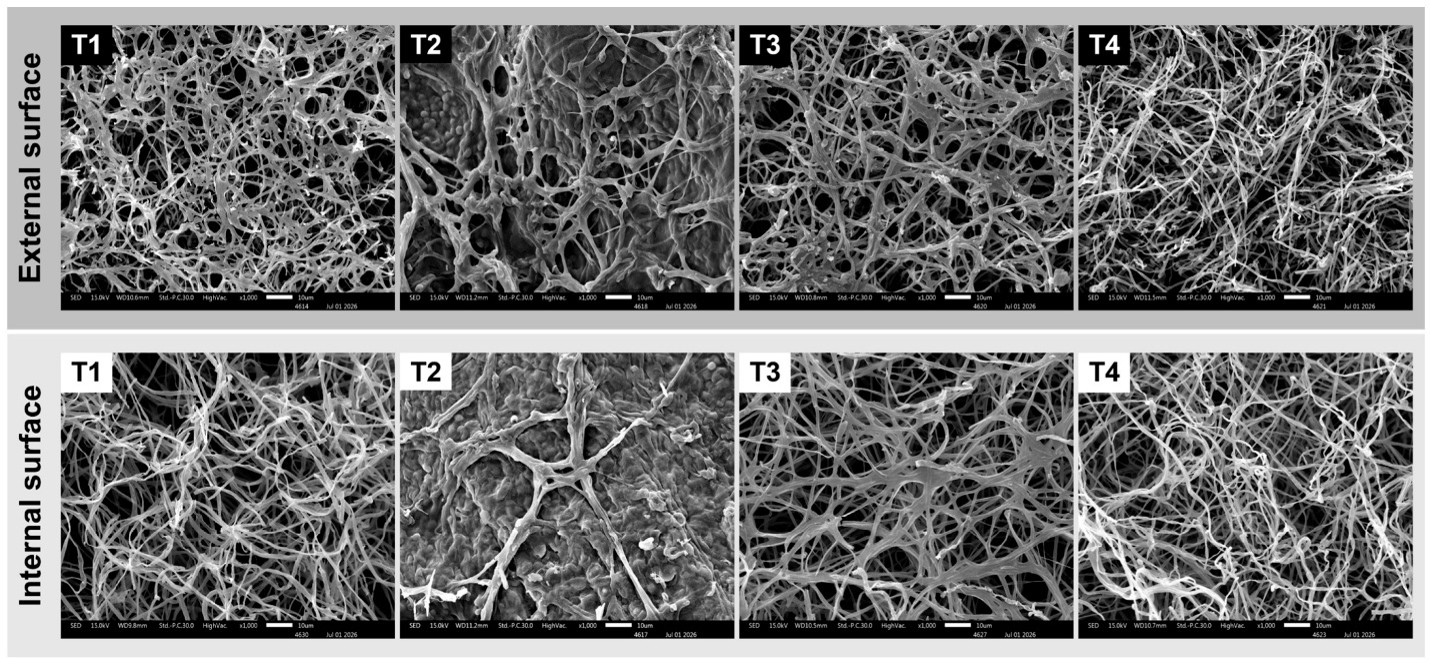
Scanning electron microscopy revealed that biomass composition affected mycelial formation, pore distribution, and network density, influencing mechanical behaviour and impact resistance T1: Corn husk-based, T2: Rice straw-based, T3: Sawdust-based, and T4: Sugercane leaf-based.
Soil burial experiments demonstrated promising biodegradation, with corn husk- and sugarcane leaf-based MBCP achieving over 60% degradation within 90 days. Phytotoxicity assays also showed no inhibitory effects on seed germination, with early seedling growth promoted in several vegetable species.
Overall, the study highlights mycelium-based cushioning packaging made from grey oyster mushroom as a promising alternative to conventional plastic and foam packaging. Changing the biomass substrate also enabled the production of composites with different properties. However, improvements in moisture resistance, manufacturing efficiency, and scalability remain necessary for wider adoption.
MDPI’s commitment to impactful Open Access research
Research has the potential to influence scientific innovation and inform policies that address global challenges. By supporting researchers and making their work accessible, Open Access publishing can help broaden the reach and impact of important scientific findings.
Discover more research, advances in Open Access publishing, and insights into MDPI’s contribution to scientific research on the MDPI blog here.
If you would like to keep reading, see the full list of MDPI Journals where you can discover the latest science, from discussions the importance of geological mapping in colonial Africa, to advances in bio-inspired robotics, pesticide applications, and more.