

Learning from Retractions to Drive Prevention Strategies
Retractions should be understood as a corrective mechanism that strengthens the accuracy and validity of the scientific record, rather than a mechanism used to punish researchers. Retractions are a valuable resource that correct the literature, prevent future researchers from propagating errors further, and help strengthen publishing practices.
Looking beyond individual cases, retractions offer a unique opportunity to identify patterns and recurring challenges within scholarly publishing. By examining these trends, publishers can strengthen the screening process, enhance quality control measures, improve support for authors and editors, and reduce vulnerabilities within the publication process.
In 2025, the three main reasons for retractions that emerged across the publishing industry include:
- Compromised peer review and/or paper mills.
- Citation manipulation/citation cartels.
- Image and data manipulation cases.
However, learning from retractions is not without its challenges. Retraction notices vary considerably in their level of detail, terminology, and transparency, making systematic analysis difficult.
Despite these limitations, we have seen publishers, institutions and the wider research community focus on improving transparency and strengthening processes to protect the scholarly record and prevent ethical breaches.
Here, we look at the retractions from 2025 and begin to understand the recurring issues that continue to challenge the publishing industry.
Trends in 2025 for retractions across the industry
Retractions are a healthy part of the publishing ecosystem. Their purpose is to correct the literature and notify readers that the findings are not reliable.
Analyzing retractions can shed light on rising ethical breaches that should be addressed by implementing new preventative actions. Retraction Watch tracks retractions across publishers’ websites and stores the information in a publicly available database.
In January, we downloaded the data for retractions reported in 2025 and categorized it within broader groups to identify the major ethical breaches throughout the year. Unsurprisingly, ethical breaches associated with the rise in Generative AI (GenAI) tools emerged.
The publishing industry has already responded to concerns regarding GenAI use. The major changes centered around developing guidelines for the responsible use of AI. This included use of GenAI tools during the peer review process by academic editors and publishers to screen for signs of ethical misconduct. An emphasis was placed on the need for human validation of AI-generated content and transparency in declaring how GenAI tools are being used by all those involved in the peer review process.
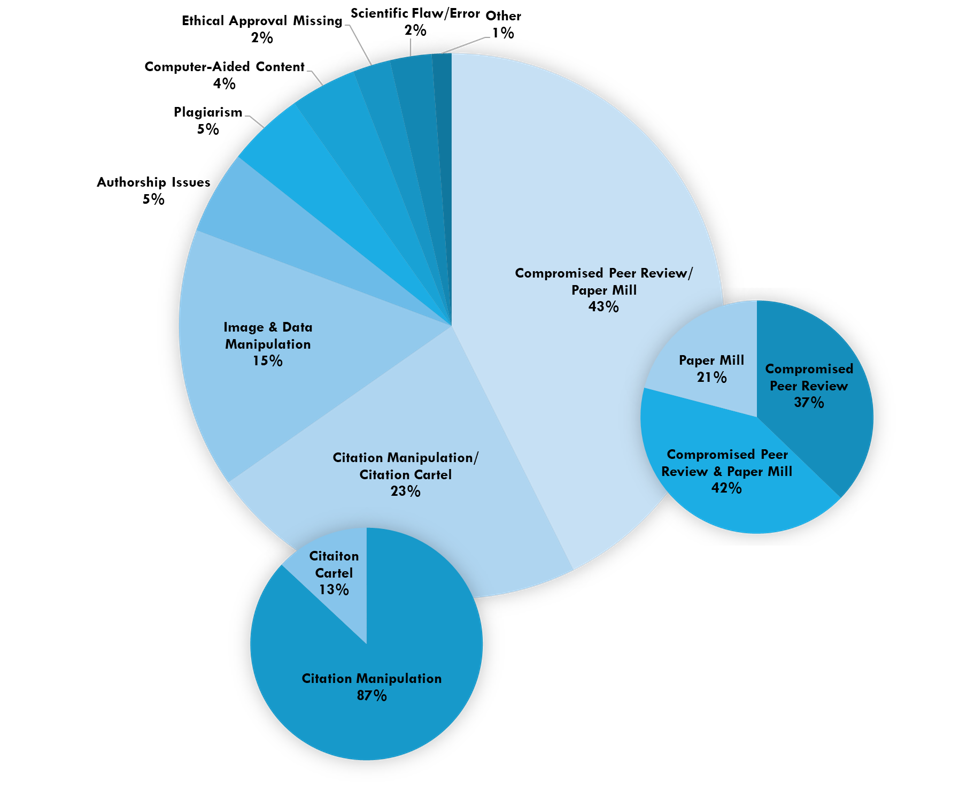
2025 Distribution of Retraction Reasons. Retraction watch data were downloaded from Crossref in January, 2026. Each retraction was assigned to a broader category based on Retraction Reason keywords and independent screening to identify the possible causes of the retraction/most severe ethical breaches. Of note, paper mills may operate undetected within journals or conference proceedings, resulting in large-scale retractions that may skew the retraction data.
Compromised peer review and/or paper mills
Taking a closer look at the distribution of retractions during 2025, we observe a rise in retractions due to paper mills, as compared to previous years. Paper mills are fraudulent organizations that produce fraudulent manuscripts and sell authorship. With GenAI tools broadly available, paper mills can generate fake manuscripts ready for submission.
The increase in retractions reflects the communal effort to identify these fraudulent organizations and correct the scientific literature, but publishers and the scientific community must remain vigilant and screen for indicators of paper mills.
While the compromised peer review/paper mill category accounted for 43% of the retractions, compromised peer review alone accounted for 37% of those retractions. This indicates that there are rogue editors operating within the peer review process. Editorial Boards have the duty to maintain the integrity and quality of academic publishing; therefore, further guidance, internal audits and training may be necessary to ensure the integrity of editorial boards.
Citation manipulation and citation cartels
23% of retractions in 2025 were due to ethical violations regarding citations. The majority of these retractions were due to citation manipulation breaches. Looking through the retraction notices, some of these articles included irrelevant or non-existent citations. This could be a sign of AI-generated text, where citations are hallucinated or authors go back and add citations without checking the context. Other instances included author excessive self-citations or “coercive citations” where academic editors or reviewers force authors to include citations.
13% of the ethical breaches related to citations could be attributed to citation cartels. Citation cartels are coordinated networks of scholars that systematically manipulate citations to artificially inflate citation metrics such as journal impact factors or an author’s H-index. This systematic manipulation can be difficult to trace and prove. In 2025, the cases that could be attributed to citation cartels appeared to be operating within conference proceedings.
Image and data manipulation
The third most common retraction reason in 2025 included image and/or data manipulation cases, accounting for 15% of all retractions. Although still a major concern, there appears to be an overall decrease in these cases as journals are integrating more tools within their processes, specifically aimed at identifying image manipulation.
The STM Integrity Hub, an industry-wide initiative, has been a driving force offering solutions and tools for publishers to detect research integrity breaches within manuscripts. Publishers, including MDPI, can test new tools and share their experience as part of this external partnership that drives innovation.
Limitations of interpreting retraction data
Interpreting retraction data requires caution and can be complex. Most retractions identify several ethical breaches within the same case. For example, an article may be AI generated, which contains manipulated citations, and be in addition to a manipulated peer review which resulted in the article being published. To categorize such cases requires identification of the main or most serious ethical breach, in this case being peer review manipulation. Therefore, categorizing retractions depends on the perspective of the screener, to a certain extent.
A further challenge is that legal and reputational considerations often influence how retraction notices are written. Publishers may deliberately avoid language that could expose them to liability claims. This results in retraction notices that are cautious or sometimes vague and ambiguous.
To avoid misclassifying the reasons for retractions and to increase transparency, clear standardized terminology is needed. This should be applied across both journals and publishers.
MDPI’s research integrity initiatives
MDPI’s Research Integrity team continues to improve its research integrity framework. Priorities focus on team expansion, investment in improved screening tools and engaging with Editorial Board members to strengthen the collaboration, in turn preventing and addressing publication ethics breaches.
Dr. Tim Tait-Jaimeson, Head of Publication Ethics, reflects on how these initiatives strengthen the editorial process:
“Ensuring the integrity of the scientific record is at the heart of our editorial mission. Alongside constructive, actionable peer review, we aim to support our Editorial Boards with the best possible information, provided through comprehensive hands-on screening processes and technological tools, enabling informed and responsible editorial decisions.”
Expanding the Research Integrity team
MDPI’s Research Integrity team has expanded to further support the robust quality assurance practices across MDPI’s growing portfolio. Under the leadership of the Head of Publication Ethics, Dr. Tim Tait-Jaimeson, the team has expanded to include an international core team of full-time Research Integrity Specialists.
The team consists of two core sections:
- Prevention and Policy – Responsible for proactive ethics risk mitigation through policy development, guidance, training, and early intervention.
- Post-Publication Investigations – Responsible for the consistent, timely, and policy-compliant handling of publication ethics concerns arising after publication.
The team is equipped to ensure that research integrity and publication ethics concerns receive the appropriate level of expert attention, with an emphasis being placed on preventative measures and further collaboration with authors, Editors-in-Chief, and affiliated institutions.
Implementing AI tools to strengthen the editorial process
The Research Integrity team works closely with MDPI’s in-house AI team to deploy AI tools across the various steps of the editorial process.
Priority is placed on integrating tools that address the most common ethical breaches in recent years, such as the rise in paper mills, citation cartels and/or citation manipulation cases, and image and data manipulation. The process maintains a transparent and human-centric approach which is key in ensuring accuracy and proper use of all AI tools.
Read more about Cite Lens, a tool to flag potentially problematic citations, and Proofig AI, a tool that assists in screening images for ethical breaches, to learn how these tools are being implemented.
The challenges of emerging ethical breaches cannot be resolved alone, and publishers need the support of the broader community. The STM Integrity Hub has been instrumental in providing publishers with tools and support in tackling research integrity issues and providing best practices and guidance. As an active member of the Integrity Hub initiative, MDPI fully aligns with their values, advocating for collaboration and open exchange to support best practices.
Strengthening MDPI’s commitment to research integrity
The Research Integrity team’s key priorities include refining processes and monitoring the performance of the AI tools that have been introduced to the editorial process. Improvements and expansion of the tools will most likely be needed to ensure they remain fit for purpose as technologies evolve.
The team will also:
- Unify integrity expertise and operations by leveraging existing knowledge and standardizing policies and processes.
- Strengthen stakeholder engagement and external leadership by working closely with editors, institutions, publishers and industry organizations.
- Promote a culture of research integrity by embedding ethical publishing practices across the organization and supporting proactive risk management and prevention.
Tim Tait-Jaimeson reflects on the future strategies:
“Research integrity is not a static goal but an ongoing commitment. As the publishing landscape continues to evolve, we will continue refining our processes, learning from emerging challenges, and developing practical solutions that support authors, editors, reviewers, and institutions.”
Although progress in publication ethics does at times require new initiatives, ultimately, upholding ethical standards with consistency and accountability is essential to maintaining a robust framework that ensures integrity.
Learn more about MDPI’s Research and Publication Ethics policies.