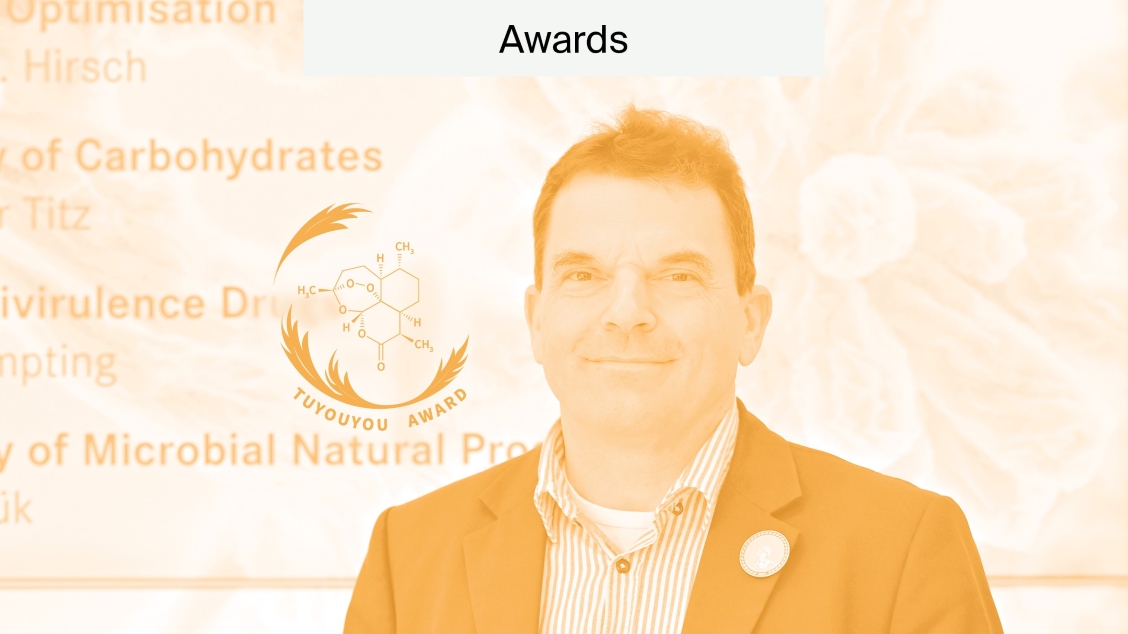
Prof. Rolf Müller: Winner of the 2024 Tu Youyou Award
The co-recipient of the 2024 Tu Youyou Award, Professor Rolf Müller, is a renowned leader in the field of natural products research.
Professor Müller has dedicated much of his career towards the development of innovative bioactive substances to combat antimicrobial resistance. Antimicrobial resistance poses a real threat to human life, with it contributing to approximately 4.95 million deaths in 2019.
Professor Rolf Müller leads the “Novel Antibiotics” research group at the German Centre for Infection Research (DZIF) and is the founding and scientific director of Helmholtz Institute for Pharmaceutical Research Saarland (HIPS), where he heads the Department of “Microbial Natural Products”.
In recognition for advancing microbial natural products isolation and biosynthesis, industrial microbiology, and biotechnology, Professor Rolf Müller was awarded the 2024 Tu Youyou Award alongside Professor Richard DiMarchi.
Read the full interview with Professor Richard DiMarchi here.
Recently, Professor Müller spoke to Dr. Ioana Craciun, MDPI Scientific Communications Specialist, sharing insights into his field, wisdom for early career researchers, and his thoughts on being a 2024 Tu Youyou Laureate.
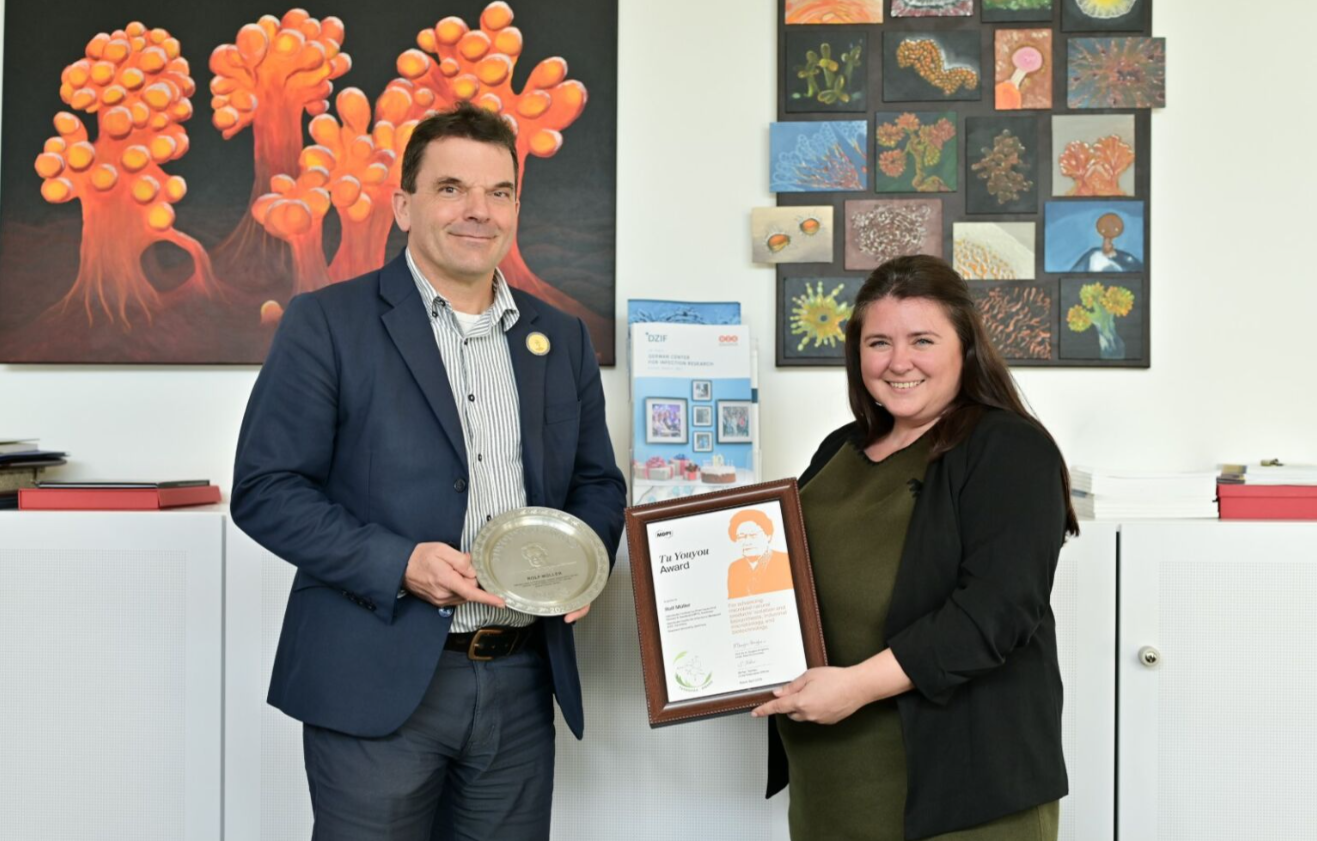
Watch the full interview with Professor Rolf Müller
Prof. Rolf Müller’s early career
While studying Pharmacy at Bonn University, Germany, Professor Müller began to develop an interest in plant natural products that would set him on a trajectory for his current success.
Despite being initially focused on plant natural products, Professor Müller would pivot his interests towards bacterial natural products, where advances in genetic and genomic tools were on the horizon.
He undertook post-doctoral work in Seattle, USA, in Heinz Floss’s lab, where he would be introduced to a class of bacteria known as actinomycetes. Working with actinomycetes, the predominant source of natural products, would give Professor Müller invaluable knowledge which he would later utilize within his work with other classes of bacteria, such as myxobacteria.
“I think for me, the main turning point was to figure out what alternative resources are there, which ones may not be that well studied and offer a lot of opportunities. This is where I got to know myxobacteria.”
Following his post-doctoral work in Seattle, Professor Müller returned to Germany as a group leader at the German Research Centre for Biotechnology. Here, Professor Müller built on the foundational work conducted by Reichenbach and Höfle and began building genetic methods for several myxobacteria.
Professor Müller would then begin a teaching position at Saarland University, Germany, where he remains–22 years later.
Setting up a new institute
In 2009, Professor Müller became the founding director of the Helmholtz Institute for Pharmaceutical Research Saarland (HIPS), an international powerhouse for natural product research and antibiotic development.
Founding a research institution is an impressive achievement. Today, Professor Müller credits much of HIPS’s ongoing success to interdisciplinary collaboration, something that has allowed his institution to grow exponentially. Muller explains:
“In my previous institution, in Braunschweig, they had strong infection research. In our local university, they had a strong Pharmacy Department. So, we decided to merge them within the Helmholtz Association […] It obviously became much more than just natural products. [HIPS] now has a large MedChem department, a large Bio-Cheminformatics Department, Drug Delivery… it’s almost 300 people.”
Interdisciplinary collaboration, he stresses, is essential. “This is inbuilt in pharmaceutical sciences”, he says. The work of Müller’s team utilizes methods from biotechnology, synthetic biology, analytical chemistry, bioinformatics and pharmaceutical sciences.
Indicative of his success, HIPS stands as the only non-university research institute in Germany dedicated to pharmaceutical research.
Fighting against antimicrobial resistance
For the past 20 years, Professor Müller and his team have dedicated their efforts towards discovering various soil bacteria and developing innovative bioactive substances to combat antimicrobial resistance. This collection now comprises over 10,000 different myxobacterial strains, with each strain providing unique natural products that can be explored to treat infectious diseases in humans.
As per the World Health Organization (WHO), antimicrobial resistance is one of the ten greatest global threats to public health. The misuse and overuse of antimicrobials continue to accelerate this issue. Therefore, these treatments should be used sparingly and only when absolutely required.
This presents a key economic challenge associated with antibiotic development, in that they are not as profitable as other pharmaceuticals. Professor Müller calls for a wider acknowledgment of their invaluable role, comparing them to essential public services:
“We, as a society, certainly have to value antibiotics better and see them much more as common goods than as something which pharma needs to make money with… like firefighters. Everybody is okay with paying for them, but nobody wants them to show up at your house.”
The challenges facing antibiotic development do not stop at funding: working with natural products requires ‘special capacities’, which many other pharmaceutical institutions do not have the resources to deliver. This is what makes HIPS unique. Müller explains how his teams follow the process ‘from early discovery to a larger fermentation capacity’, capitalizing on the multidisciplinary expertise they have within the institute.
However, despite affirming that natural products provide ‘fantastic tools’, he acknowledges how they are not always guaranteed to be suitable for human usage. For Müller, success means getting an antibiotic to market, which is a complex process that requires adaptability and perseverance:
“They may well kill a pathogen, but maybe not be good for application… Then you need to understand what to change… whether by total synthesis, fermentation, or semi-synthesis. I don’t care; I want it to be successful.”
Reflection on the award
Throughout his career, Professor Müller has acquired an inspirational catalogue of achievements. In addition to the Tu Youyou Award, he is also a recipient of the Gottfried Wilhelm Leibniz Prize, the PHOENIX Pharmacy Research Award, the DECHEMA Prize, and the Inhoffen Medal.
For him, however, many of these accolades rest on the exceptional efforts of his team. In the case of the Tu Youyou Award, this is no different:
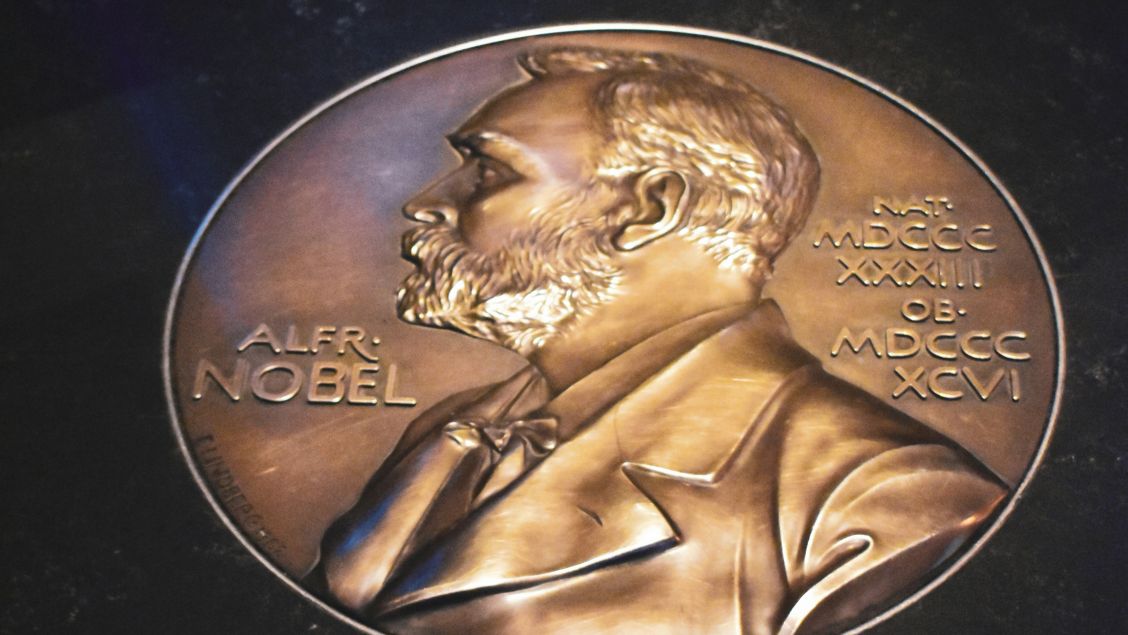
“… I take this as a prize for the team and less for myself. And I think the team really highly appreciates this award and its dedication to Nobel Prize Laureate Tu Youyou.”
Further, awards such as this one contribute essential funding towards Professor Müller’s efforts and boost the visibility of his important work. For this, he remains greatly appreciative of this recognition:
“As a field, we certainly for our future need more success stories, right? They don’t necessarily have to have a Nobel Prize, but we need some compounds that make it to the market or make it to an application to be successful, also in achieving funding. So, for this, I highly appreciate this award.”
Advice for young scholars
In an editorial prepared by the Tu Youyou Award Committee, Professor Müller is praised for his contributions not just within the industry, but also academia. He has lectured all over the world and continues to dedicate his time in nurturing the next generation of researchers.
Upon the walls of Professor Müller’s office hang paintings of myxobacteria created by his students. When asked if he had any advice for emerging scholars, he encouraged them to embrace their creativity:
“Use your creativeness and do what you think you wish to do. I think this is the big advantage of being an academic researcher: you’re not necessarily bound to the economics in a company.”
Secondly, he states that persistence is key:
“And with natural products, be stubborn. The best projects we have, they died or almost died several times. And then you need somebody who has this capacity to rethink, go back to square one, study it all over, and overcome the hurdle. I think this is super important, and don’t give up too early.”
Returning to his advocacy of interdisciplinarity, he encourages early-career researchers to “get yourself set up for that mixture of abilities that you need”. In his final piece of advice, he reminds his students to look beyond publications. Instead, he places the value of their knowledge within its application:
“Quite often you hear the argument, but I need to publish, I need to sort a high-impact journal, blah, blah. No, we need to educate the next fantastic round of people, and we need to have some products.”
2026 Tu Youyou Award
The MDPI Tu Youyou Award will open for nominations in 2026 for researchers who have made outstanding contributions to the fields of medicinal chemistry and natural products chemistry.
Visit the Tu Youyou Award website to learn more.
Celebrating and recognizing the achievements of researchers is central to MDPI’s mission to foster high-quality Open Access scientific discussion. MDPI is committed to ensuring that awards such as these inspire academics to continue their incredible work.
Click here to learn more about MDPI’s Awards program.