
Improving Elderly Monitoring Systems with Ambient Sensing Technology
In Europe and North America, it is estimated that 1 in 5 older persons live alone, which is increasing reliance on technology to monitor their wellbeing. While wearable sensors and camera-based solutions offer some reassurance in detecting falls and emergencies, users are reluctant to accept them because they are difficult to use and raise privacy concerns.
Ambient sensing technologies such as radar, thermal cameras, and smart plugs can offer better monitoring while preserving the user’s privacy. However, no single option offers the balance of affordability and efficiency needed to make them viable solutions.
A recent study published in the Open Access journal Sensors explores the potential of a holistic approach combining the three technologies into one elderly monitoring system.
Corresponding author Dr Yangang Xing explains:
By combining these three technologies, we can establish a complete picture of how someone is coping at home. As well as detecting emergencies, it could provide an early warning if a person’s mobility or daily routine begins to deteriorate.
Drawbacks of standard monitoring systems
Current monitoring systems typically rely on cameras and wearable monitoring technologies. Both types provide direct detection of falls, mobility, and daily activities. While effective in theory, some users find them intrusive and difficult to implement correctly in realistic scenarios.
The effective use of monitoring cameras should provide enough coverage of the home and adequate visual detail. Occlusion from furniture and limited fields of view can make monitoring difficult, often requiring more cameras than is practically viable. Additionally, users avoid placing cameras in some of the highest-risk locations for older adults such as bathrooms and bedrooms, due to concerns of loss of privacy, further reducing their practical use.
Wearable technologies address some of the privacy concerns associated with cameras but are met with other disadvantages, particularly for older users. Robust data collection relies on continuous use, proper body positioning, and can be affected by clothing interference, making them unreliable in many scenarios.
These concerns have sparked interest in different kinds of sensors that can support ageing in place by providing a more complete picture of the environment and activities at home while maintaining privacy.
Integrating ambient sensing technologies in monitoring systems
Moving away from individual tracking sensors such as cameras and wearables, the current study is focused on ambient sensing technologies. From the wide classes of available sensors, the authors focus on three promising candidates:
- Consumer-grade radar sensors: affordable and effective in darkness and through some walls, though they lack the detail needed for fall detection in critical zones such as over the bed or near doorways.
- Low-resolution thermal arrays: efficient at posture recognition (walking, standing, sitting, or lying) and fall detection, but are susceptible to occlusions due to heat sources.
- Smart plugs: track appliance usage via unique load signatures of each device, which can inform changes in domestic routine and sleep disturbances without direct observation of the user.
While all categories present drawbacks that prevent them from being used individually as full monitoring systems, there is potential in applying multimodal setups like the one represented in Figure 1. The proposed architecture combines features from multiple sensors in the late fusion stage to better detect postures, emergency events, and daily routines.

Figure 1: Proposed multimodal architecture using radar and thermal technologies for activity recognition and appliance monitoring through smart plug telemetry.
Testing a radar–thermal–smart plug setup in realistic environments
At the centre of this framework are two different types of detection systems that require distinct experimental setups for testing: the radar–thermal sensing sector for motion and posture detection, and the smart plugs sector to capture device activation.
The radar–thermal sector was tested in a lab room with one radar sensor mounted on a wall and a ceiling-mounted thermal array pointing downwards, as seen in Figure 2. By using 6 different configurations of furniture across 26 recorded sessions, researchers determined the efficiency of each detector, both independently and in conjunction with each other.
They monitored four categories: walking, standing, sitting, and lying. These four categories were chosen as representative of an older person’s activity at home and are often used to assess sustained physical activity, sedentary habits, and prolonged recumbency.
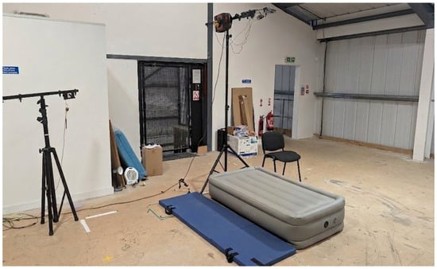
Figure 2: Lab room setup to test the radar and thermal sensors with varying furniture configurations.
The device-monitoring sector of the architecture was tested using 16 smart plugs on three types of appliances:
- Resistive loads, such as kettles and toasters,
- Multi-state loads, such as microwaves and fridges,
- Continuously variable electronic loads, such as computers and monitors.
The smart plugs report active power, scalar power factor, current, and voltage of the device they are connected to. This information is then fed into machine learning models in a training, validation, and test pipeline. These models make use of 16 statistical features of the electrical data to dynamically identify devices via unique signatures, making the setup fully interchangeable and scalable.
An optimal setup layering smart technologies
Both the radar and thermal arrays proved to be efficient at detecting binary motion (walking versus any of the other categories) . However, the radar stands out due to its affordability, larger field of view and robustness against occlusion by furniture, making it sufficient for determining in-bed versus out-of-bed signals in care homes.
The results strongly support the addition of thermal arrays to high-risk zones, like chairs or beds. This allows monitoring to distinguish between postures, such as falling versus sitting on a bed or lying versus sitting in a chair. The fusion of radar and thermal signals showed significant improvement in posture detection efficiency over both individual modalities.
Beyond reliable device identification, smart plug data enables the inference of appliance-mediated activities like making tea and walking away versus sitting for desk work at a computer. This complements the radar–thermal sector by providing contextual evidence for detections.
In this architecture, a hierarchy emerges:
- Radar sensing serves as a base layer of continuous spatial monitoring;
- Thermal sensors act as a secondary layer targeting high-interest zones and backing up radar signals;
- Smart plugs provide context, spatial anchors, and routine monitoring.
While promising, this architecture requires further testing to be fit for realistic cases. Of particular concern is the introduction of multiple subjects with different body sizes and gait patterns, as well as varied room sizes and geometries.
Furthermore, device detection results are limited to the chosen appliance classes. Further research is needed for the system to be applicable across all homes and devices.
Dr Yangang Xing concludes:
The technology could ultimately allow older people to stay in their own homes for longer, giving them confidence to go about their daily business while feeling secure in the knowledge that their health and wellbeing is monitored without infringing on their privacy.
MDPI’s commitment to impactful Open Access research
Research has the potential to influence scientific innovation and inform policies that address global challenges. By supporting researchers and making their work accessible, Open Access publishing can help broaden the reach and impact of important scientific findings.
Discover more research, advances in Open Access publishing, and insights into MDPI’s contribution to scientific dissemination on the MDPI blog.
Find further research on ageing in place, remote health and wellbeing, and the applications of new technologies across MDPI’s Open Access journals Geriatrics, International Journal of Environmental Research and Public Health, and Sensors, or access the full MDPI journal list here.