


MDPI’s AI-powered ROR Entity Search API: Reliably Mapping Institutions at Scale
Reliably mapping institutions featured in the affiliations of scientific research is difficult at scale due to inconsistent patterns of naming. This stems from affiliations being translated differently, including departments or faculties, and lacking standardised formatting, amongst other things. Ultimately, having such inconsistent metadata can impact data analysis and reporting, discoverability, and prevent process automation across the publication lifecycle.
Leveraging the persistent identifiers in the Research Organization Registry (ROR) known as ROR IDs, MDPI’s AI-powered ROR Entity Search API has been developed, turning messy, free-text affiliations into standardised ROR IDs to support accurate analytics and organisation-aware workflows across MDPI. The tool is also being released as a freemium API and open source, meaning anyone can integrate it and benefit from its features.
Here, we outline the context behind developing the API and its use cases, with input from Diogo Rodrigues, Data Scientist Lead.
Affiliation naming is inconsistent in scientific research
Reliably linking authors and institutions is critical for analytics, reporting, and process automation; however, affiliations are highly inconsistent and can appear in dozens of formats, languages, and abbreviations.
For example, one institution can appear in different ways:
- Laboratory of Physical Chemistry, ETH Zürich, 8093, Zürich, Switzerland
- Laboratory of Physical Chemistry, ETH Zürich, Vladimir-Prelog-Weg 2, CH-8093, Zürich, Switzerland
- ETH Zürich – Laboratory of Physical Chemistry
- Laboratory of Physical Chemistry, ETH Zürich
Reflecting on why having such inconsistent metadata is an issue, Diogo Rodrigues explains:
For many data analytics and AI tasks, it is essential to have rich and consistent metadata about our manuscripts, including clear information on who the contributors are and where they are affiliated. Accurate institution identification is critical to enable reliable analysis, reporting, and integration with other systems, as well as upholding research integrity through identity validation.
ROR IDs
The Research Organization Registry (ROR) emerged as a community-led dataset that aims to provide a persistent identifier for every organisation in the world, including universities, hospitals, institutes, funders, and more.
ROR IDs complement other identifiers such as ORCID for researchers and DOIs for research outputs. The registry data are under a CC0 license and therefore openly available and searchable via an interface.
In practice, from the four examples of affiliations above, there would be 2 ROR IDs:
- ror.org/00v171g37 – for the Laboratory of Physical Chemistry at ETH Zurich.
- ror.org/05a28rw58 – for ETH Zurich.
ROR IDs are therefore highly useful for identifying and understanding affiliation data, though applying this at scale remained a challenge, such as for MDPI’s 500+ journals and their respective outputs.
In response, MDPI investigated whether a solution could be developed to further leverage the benefits of ROR IDs in relation to its journal output.
AI solutions
Regarding AI solutions, Diogo Rodrigues outlines how:
AI solutions help bring standardization and consistency to complex workflows, while enabling stakeholders to access richer and higher-quality data. For editors, peer reviewers, and publishers, this means they can perform their tasks more rigorously, make better-informed decisions, and deliver a higher level of service.
AI can reduce ambiguity in metadata and uncover insights that would be difficult or time-consuming to obtain manually.
Until recently, approaches for affiliation metadata were useful in narrow cases but struggled with semantic variation, of which there is an abundance of in affiliation naming, as shown in the example of four institution names above. Furthermore, they would quickly become obsolete due to new organisations being added to the registry or departments restructuring, meaning the tool would require ongoing maintenance.
So, MDPI needed to develop a tool that could handle the diverse naming of affiliations as well as the consistent influx of new organisations.
What is MDPI’s ROR Entity Search API?
Diogo Rodrigues explains:
The need for precise and scalable affiliation disambiguation was one of the main drivers behind the development of this tool.
MDPI’s AI-powered ROR Entity Search API matches free-text affiliation strings (e.g., “Dept. of Physics, MIT, Cambridge, USA”) to records from ROR (in this example, ror.org/042nb2s44). The tool returns the matched institution’s name, ROR ID, country, and city.
All the user has to do is to input the free-text affiliation into the search bar to receive the information in response. For example, during the submission, authors can input the free-text affiliation and the system will suggest the standardized institution name.
Please note, because the tool is an affiliation disambiguator, only affiliation strings can be inputted for the tool to function properly. Any inputs that are dissimilar will impact performance.
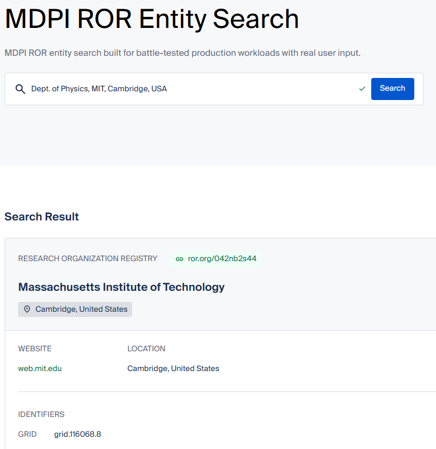
MDPI ROR Entity Search tool.
Why use this tool?
Diogo Rodrigues outlines the benefits as the following:
One of the core advantages of our tool is its simplicity and modularity. ROR data is updated monthly with corrections and newly added institutions, so it is crucial to have a system that can incorporate these changes immediately, ensuring that every search is performed on the most up-to-date organizational data.
Our tool was designed specifically to make this rapidly changing dataset easy to maintain. It uses a two-layer architecture: an easily adaptable representation of the ROR data, and a separate search layer that interprets affiliation strings and maps them against this up-to-date representation. This separation allows us to refresh the underlying data frequently without changing the search logic. In contrast, many existing systems are more monolithic and therefore harder to keep synchronized with the fast-paced updates of the ROR registry.
Alongside providing up-to-date information, the tool also improves metadata quality by increasing the ROR metadata field on MDPI articles deposited to Crossref, therefore increasing interoperability between platforms, funders, and index bodies.
How the tool functions
The system combines various technologies to function seamlessly:
- Named entity recognition which enables the extraction of institution entities.
- Dense embeddings which represent their semantic meaning.
- Vector search to retrieve the most likely ROR matches.
This approach allows for handling the noisy, incomplete, and multilingual inputs whilst importantly remaining resilient to variation in how institutions are referenced.
As an API, the tool can be integrated seamlessly into different workflows; Diogo Rodrigues explains:
We chose to release the solution via an API so that multiple internal teams can integrate it seamlessly into their own systems. The API provides two search modes tailored to different use cases:
- A mode that returns all ROR IDs found in each affiliation string, which is ideal for database population and batch workflows.
- A top‑k suggestion mode that returns the most similar ROR IDs to a given affiliation string, which is better suited for user-facing interfaces and interactive suggestion features.
These two modes allow teams with very different workflows to leverage the same core AI-driven search capabilities, while still meeting their specific requirements.
How it is integrated into workflows at MDPI
The tool has been used for more than 1 year by internal teams at MDPI.
It is integrated into MDPI’s in-house submission system (SuSy), providing real-time affiliation suggestions to standardise institution names as authors proceed through the submission process. Over time, this will mean that the affiliation metadata of MDPI articles will become increasingly standardised and interoperable.
Scilit is a free and comprehensive content aggregator platform for scholarly publications, hosted by MDPI. It has more than 120 million distinct affiliations; since integrating the API, the mapping of affiliations to institutional identifiers has increased by 20%, from around 69 million to 96 million. In practice, this means that institution pages are populated with standardised affiliation data across the platform.
Finally, across various teams, the API and tool are being used to create dashboards and reporting. For example, the Institutional Open Access Partnerships program can now better quantify research output for institutions that are part of the program, leading to better data and analytics.
External use cases
The tool is being released as freemium API and open source so that external users can integrate it into their workflows on their own or via the API. This means increasing metadata quality not just at MDPI, but also across the scientific community, extending MDPI’s commitment to openness to beyond its journal portfolio.
On how the tool will benefit external users, Diogo Rodrigues explains:
This tool empowers researchers, institutions, and publishers to conduct large-scale affiliation data analytics with improved efficiency and accuracy.
Through the freemium API, users will be able to submit bulk requests containing large numbers of affiliation strings and obtain disambiguated ROR IDs with minimal effort. At the same time, we provide the open-source code for users who require deeper integration or customization. This gives them more control over deployment at the cost of higher integration effort.
Institutions and organisations, such as universities, libraries, or publishers, that do not have the resources to build their own institution disambiguation systems can benefit from this API. Essentially, integrating this tool would empower them to perform large-scale processing with low effort.
For example, a library seeking to standardise their data sources across their catalogue would be able to integrate the API and receive standardised ROR IDs for the institutions publishing the research they host and manage.
Enhancing metadata quality at scale
MDPI’s AI-powered ROR Entity Search API turns messy, free-text affiliations into standardised ROR IDs to support accurate analytics and organisation-aware workflows across MDPI and beyond.
Accurately identifying institutions in scientific research is critical for reliable analysis, reporting, and integration with other systems. MDPI’s solution is being utilised across internal teams to reduce ambiguity and access deeper insights; further, the tool is open to all as freemium API and open source, in line with MDPI’s commitment to openness, transparency, and accessibility.
Click here to try the tool for yourself by inputting affiliation text in the search bar.