
Engineering the Underground: How Microbial Inoculants Provide Sustainable Agriculture Alternatives
A growing global population means food production will need to increase by 70% by 2050. While the technology exists to increase crop yields, more sustainable methods of managing the soil will be needed to protect this vital resource.
Soil is a non-renewable resource on human time scales. It forms so slowly that once it is lost or degraded, it cannot be replaced within a human lifespan. Around 40% of the world’s soil is already degraded, driven by intensive agriculture, overuse of chemical fertilisers, and climate change.
This has created an urgent need to reduce global dependence on chemical fertilisers and find more sustainable ways to manage soil health. One increasingly promising solution is the use of microbial inoculants, beneficial microbial communities introduced into the soil to support plant growth. These microbes can improve nutrient availability, strengthen soil structure and help protect crops from pests while reducing the need for chemical inputs. Overall, aligning with the principles of sustainable agriculture.
Plant growth-promoting microbes recycle nutrients, increase nutrient uptake, and protect plants from pathogens.
However, despite their potential, microbial inoculants remain an emerging technology. Expanding their use at scale will require a better understanding of microbial-plant interactions, identification of robust strains, and the development of new strains to enhance beneficial traits.
From soil ecology to agricultural tool
The domestication of wild plants roughly 12,000 years ago saw a shift from hunter-gatherer societies to permanent settlements.
Agriculture has relied on soil health long before the science was understood. Crop rotation, for example, helped maintain soil fertility by maintaining stable microbial networks in soil. This changed dramatically during the Green Revolution in the 20th century, when synthetic fertilisers became central to food production. While this helped drive huge increases in crop yields, their widespread use contributed to soil degradation.
Advances in soil science formed the understanding that soil is a living ecosystem where microbial communities influence nutrient cycling, plant growth, and disease resistance. Further, modern sequencing technologies have shown these underground interactions to be far more complex than previously thought.
As concerns grow over declining soil health and the environmental impact of intensive agriculture, research is turning to biology for more sustainable solutions. A review article published in the Open Access journal Plants highlights current progress in microbial inoculant research, key challenges, and future opportunities. Researchers are now focused on identifying microbial strains that provide reliable benefits across different crops, climates, and soil types.
Microbial inoculants in action
Plant growth-promoting microbes support crops through numerous biological mechanisms, as highlighted in a review published in the Open Access journal Applied Microbiology. These beneficial plant-microbe interactions can:
- Protect plants from soil pathogens.
- Increase nutrient availability in nutrient deficient soils.
- Facilitate water absorption during drought conditions.
Together, these mechanisms improve crop resilience while reducing reliance on chemical fertilisers. One of the clearest examples of this is phosphorus management, where microbes help unlock nutrients already present in the soil.
Phosphate-solubilising microorganisms and nutrient recovery
Phosphorus is one of the most important nutrients required for plant growth.
Although modern agriculture relies heavily on phosphate fertilisers, much of the phosphorus added to the soil quickly becomes chemically bound into forms that plants cannot absorb.
Phosphate-solubilising microbes offer a more sustainable way to optimise phosphorus use. Through biological activity, these microbes release phosphorus stored in insoluble forms, improving availability to plants and reducing fertiliser demand (Figure 1).
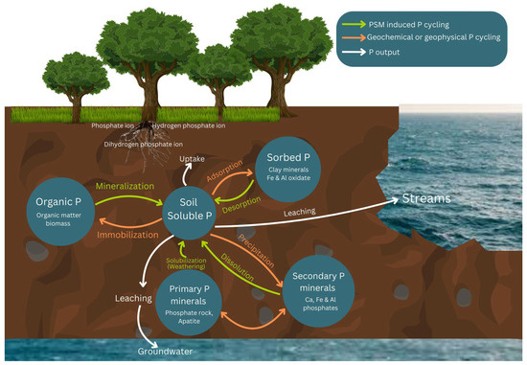
Figure 1: The biogeochemical cycle of soil phosphorus. Microbe-induced reactions increase the amount of phosphorus available for plants.
A review article published in the Open Access journal Agriculture presents several studies exploring the use of microorganisms as phosphorus mobilisers in soil. These studies demonstrate that phosphate-solubilising microorganisms can help alleviate the effects of drought stress, reduce the amount of phosphate fertiliser required for optimal crop productivity, and in some cases potentially replace chemical fertilisers completely.
However, their use in agriculture remains inconsistent. A study published in the Open Access journal Agronomy found that combining phosphate-solubilising bacteria with straw compost significantly improved ryegrass growth in the absence of fertiliser.
Improving inoculant performance requires looking beyond soil conditions. Researchers are also focusing on identifying species that are naturally more resilient and capable of performing multiple beneficial functions under environmental stress.
Using Bacillus species to overcome drought stress
Among microbial inoculants being explored for agricultural use, Bacillus species are some of the most widely considered.
Their popularity largely comes from their ability to form highly durable endospores that survive heat, drought, and nutrient limitation. Further, their biological versatility means they can promote plant growth by enhancing nitrogen fixation, dissolving phosphorus, plant hormone production, and inducing systemic resistance (Figure 2).

Figure 2: Overview of the role of Bacillus strains as biofertilisers in research.
A study published in the Open Access journal Microorganisms tracked reports using Bacillus biofertilisers in scientific literature between 1985 and 2023. It identifies an exponential growth in research output from 2003 onwards highlighting the growing interest in using these species to develop novel sustainable agricultural tools.
The analysis states that future research directions should focus on identifying more efficient strains of Bacillus bacteria. An example of this explored the soil microbiome of the hyper arid Atacama Desert in Chile to isolate drought-tolerate strains with strong plant-growth promoting activity. These findings suggest that microbes naturally adapted to extreme environments could improve agricultural inoculants.
Other studies continue to show Bacillus can alleviate drought stress and increase crop yield in arid areas by increasing microbial diversity and enhancing nutrient availability. Understanding these mechanisms could enable tailored microbial communities for specific crops and soils.
Engineering the future soil microbiome
Synthetic microbial communities are designed cultures consisting of multiple known microorganisms. They are designed to mimic natural soil microbiomes by enabling functions that promote plant growth while also working together to create metabolic networks that aid each species’ survival.
Application of these communities has been shown to significantly enhance growth in crops such as black pepper (Figure 3). This study combined four beneficial microbial strains, each contributing different plant-growth promoting benefits:
- Bacillus subtilis – Boosts nutrient uptake and disease resistance.
- Trichoderma harzianum – Promotes root growth and stress tolerance.
- Trichoderma asperellum – Supports plant defence and nutrient mobilisation.
- Aspergillus species – Improves nutrient cycling and soil health, particularly supporting the microbial community in the rhizosphere.
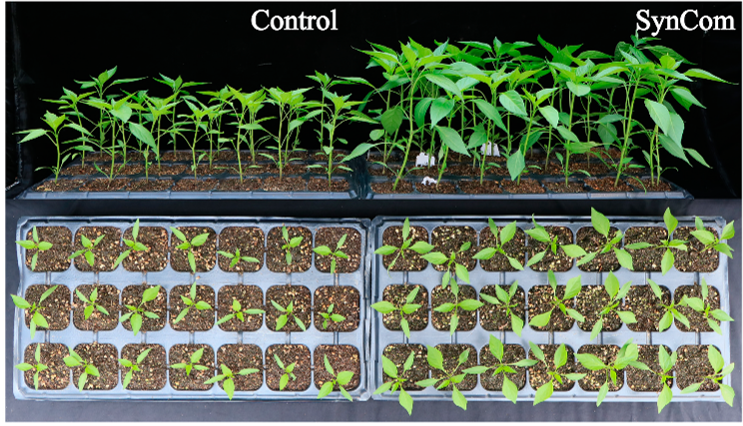
Figure 3: The effect of introducing synthetic microbial communities on growth of black pepper plants.
A review article highlights both the promise and limitations surrounding synthetic microbial communities. Despite the promising potential, reported inconsistency of using these treatments in agricultural settings is a major limitation. However, combining microbiome science with machine learning and artificial intelligence may accelerate the identification of beneficial microbial combinations and improve prediction of microbial interactions.
In the future, these tools may enable the design of precision-tailored soil microbiomes optimised for specific crops and environmental conditions.
Turning soil microbiology into agricultural technology
Despite their potential, microbial inoculants are yet to be widely adopted across modern agriculture. One of the biggest challenges is consistency. Microbes that perform well under laboratory conditions often behave unpredictably in agricultural soils, where factors such as temperature, soil chemistry, moisture, and competition with native microbial communities can all influence their survival and effectiveness.
Another challenge is scalability. Developing inoculants that remain stable during storage, transportation, and field application is essential for commercial use. In many cases, microbial strains must also work across multiple crop species and environmental conditions to be economically viable for farmers.
As research continues, improving microbial survival, formulation methods, and long-term field performance will be critical for transforming microbial inoculants from promising experimental tools into reliable components of sustainable agriculture.
More insights into different aspects of soil science can be found in Exploring the Field: Soil Science.
Studies on soil health and its applications in agriculture can be found across the portfolio of MDPI journals covering Environmental and Earth Sciences.
Alternatively, you can access the full MDPI journal list here.